Sunday, February 24, 2008

5 LDS Interpretations of the Isaiah Passages that Should Not be Perpetuated

I promised some posts on upcoming Book of Mormon Sunday School lessons. But I have to warn you, I've been in a blue funk lately. So I suspect my thoughts are neither inspiring nor fit for Sunday School consumption. But maybe it will help you know what not to say.

LDS Sunday School students will soon take a quick leap through 13 chapters of Isaiah which are quoted by Nephi in 2nd Nephi chapters 12-24. All too often, some uniquely Mormon interpretations are given to these chapters which merit a critical analysis. In this post I present five Mormonisms which I believe hinder a deeper and more accurate understanding of Isaiah's writings.

1. 2 Nephi 12:2,3 Popular LDS commentary on this verse identifies it as Isaiah's vision of people from many lands coming to Salt Lake City, Utah.

Many prophecies of Isaiah are dual and can be applied to more than one time, situation or people. I am aware that latter-day prophets and apostles have related this verse to the Salt Lake temple or even to the Conference Center from which the word of the Lord is issuing forth in these days. However, if we insist too strongly on this Mormon-centric view, we can miss the primary application which this verse has to the millennial reign of the Messiah. The word "mountain" as used in the Bible is a metaphor for "nation," "government," or "political system." In verses 2 and 3 Isaiah is speaking of the millennial condition when Christ shall establish the political Kingdom of God upon the earth. This will be established "in the top of the mountains," or in other words "as the head of the nations."

2. 2 Nephi 12:3 Isaiah wrote that the word of the Lord will come from Jerusalem, and the law will come from Zion, the New Jerusalem, located in Jackson County, Missouri. There will be two distinct centers of influence for God's people.

This may be, but verse 3 should not be used as a proof-text. Here we have a synonymous chiastic parallel where

the Law = the Word of the Lord, and
Zion = Jerusalem (one and the same)

The chiastic structure of this phrase indicates that Isaiah equated Zion with Jerusalem (the one located in Israel!) If we accept this, we will be able to learn more about Zion as it relates to the ancient City of David.

3. 2 Nephi 12:9 In the Book of Mormon, verse 9 is clarified by adding the word "not" to the following statement: "And the mean man boweth [not] down and the great man humbleth himself [not], therefore forgive him not."

This verse actually makes much more sense in its original context, without the extra "not" added in the Book of Mormon version. Verse 8 speaks of idols which are found throughout the land. And the mean (common) man and the great (important) man boweth down (to these idols). This version makes more sense coming as it does right after the description of people worshipping idols, the work of their own hands.

4. 2 Nephi 12:13-17 Some Mormons still insist that this passage is an example of the restoration in the Book of Mormon of passages that were lost in the Old Testament. As noted in footnote 16a, “The Greek (Septuagint) has ‘ships of the sea.’ The Hebrew has ‘ships of Tarshish.’ The Book of Mormon has both, showing that the brass plates had lost neither phrase.”

Pike and Seely have shown the challenges of accepting this interpretation. I love the poetry of the passage and find that the addition of the extra phrase and other interjected words spoils the beauty of the chiastic tripled bicola. Isaiah used poetic conventions frequently to emphasize his points. The Book of Mormon addition does not enhance the poetic structure of the passage, but instead inhibits it. The Greek "ships of the sea" and the Hebrew "ships of Tarshish" are probably different translations of one original phrase and it is not necessary or preferable to include both. Observe the perfection of the Masoretic text with the pattern of w- (conjunction) + al (preposition "upon") followed by kol- ("all/every") and then two words (here in English translation):
For the day of the LORD of hosts shall be

upon every one that is proud and lofty,
and upon every one that is lifted up; and he shall be brought low:


and upon all the cedars of Lebanon, that are high and lifted up,
and upon all the oaks of Bashan,


and upon all the high mountains,
and upon all the hills that are lifted up,


and upon every high tower,
and upon every fenced wall,


and upon all the ships of Tarshish,
and upon all pleasant pictures (fine craft)


and the loftiness of man shall be bowed down,
and the haughtiness of men shall be made low;


and the LORD alone shall be exalted in that day.

(if all this fascinates you, there is a well-reasoned apologetic view here. But I stand by my opinion.)

5. 2 Nephi 14:1 The Mormon speculation on this verse goes as follows: With so many men killed in war, righteous single priesthood holders are in short supply. Thus, plural marriage is reinstituted, with many women stating they will support themselves in order to receive priesthood covenant protection.

My examination of the Hebrew of this verse makes me confident in translating "one man" as "a certain man." The verse thus teaches that in the latter day seven women (symbolic number of completeness, denotes the covenant people) shall take hold of a certain man (guess who that would be?) and ask him "let us be called by thy name," which will take away their reproach (effects of atonement). In my view this verse is Messianic and has nothing whatsoever to do with polygamy.

Update: Our SS teacher gave 2 of these very interpretations while presenting the lesson! How about yours??


*

Labels: , , , , ,

Saturday, January 12, 2008

Feminist Musings on the Story of Jephthah


Whenever I come across an odd story in the Old Testament, I feel compelled pull it apart and try to make some sense out of it. Why is it there? Does it have some symbolic meaning of which we are unaware? Are we misinterpreting crucial aspects? Would it make more sense within the cultural milieu? Such is the story of Jephthah, one of the Biblical judges.

This strange little story begins with an "unlikely hero," Jephthah, the son of a prostitute. He was taken into his father's family and raised there, but after the death of his father the legitimate children forced him to leave. He made some reputation for himself among a band of "vain men," so that when his countrymen needed help against the Ammonites, they came to him. Jephthah agreed to captain an army against Ammon, in return for being named their titular head. His first military action was an attempt to negotiate with the enemy. When that did not work, he gathered together the men of Israel. The Spirit of the Lord came upon Jephthah, and he went forth to battle, making a interesting vow to the Lord. If the Lord would help him win the battle, he would dedicate to the Lord and offer up for a burnt offering whatever should come forth from the doors of his house to meet him when he returned.

After a successful conquest, Jephthah returned home and was greeted by his daughter, his only child. That she was a precious and only child is pointed up by the fact that the judges immediately before and after him were Jair (who had thirty sons who rode on thirty ass colts), and Ibzan (who had thirty sons and thirty daughters). The number of children is the only fact we are told about these two judges, making it very likely that they are there solely for the reason of emphasizing Jephthah' only begotten child. But she was a female.

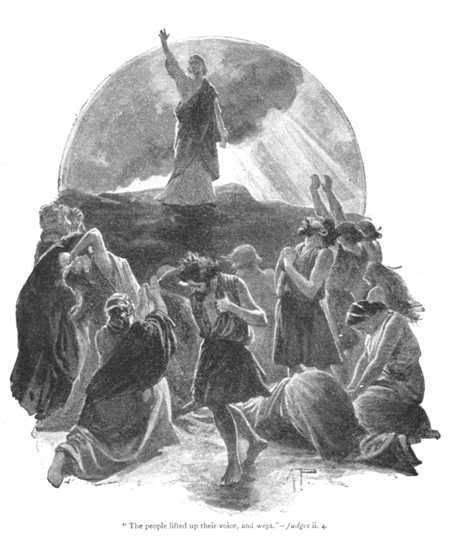
Not only was human sacrifice forbidden by the Lord, (Deut. 18:10), but burnt offerings were to be firstborn males (Lev. 1:3). Nevertheless, Jephthah had made a vow, and intended to keep it. His daughter acquiesced, asking only for two months time to go up to the mountains with some friends and "bewail her virginity." At the end of the two months, she returned to her father, and he "did with her according to his vow which he had vowed, and she knew no man." Thereafter it became a custom for the daughters of Israel to go up four days in a year to lament the fate of the daughter of Jephthah.

The tradition of Biblical scholars is to interpret this vow of Jephthah's as an impetuous and evil action which had disastrous consequences. That Latter-day Saints have followed in this tradition is clear from the chapter heading of Judges 11: "He makes a rash vow which leads to sacrifice of his only daughter."

This interpretation is problematic for at least two reasons. First, if this was a "rash vow," why would the Lord be given credit for bringing about the victory of Jephthah's army? In the Book of Judges, the people are punished with captivity and defeat when they forsake the Lord. Second, why would Jephthah make such a vow? Did he think perhaps an animal would be the first out the door to greet him? (In ancient Israel the animals were sometimes kept in the house.) What if the animal was an unclean one, such as a dog? To offer up such a sacrifice would be a great affront. But perhaps the greatest problem Biblical scholars face in the exegesis of this passage is the inclusion of Jephthah in Hebrews 11--the "faith chapter." Here Jephthah is included along with the great heroes of the Old Testament in obtaining "a good report through faith."

I rather favor an interpretation that became popular in medieval times--that Jephthah was promising only to dedicate his daughter to the Lord and not to kill her. This would parallel Jephthah's daughter more to Samson and to Samuel than to Abraham's sacrifice of Isaac. But it would preserve the Messianic shadowing. Several points make this interpretation possible:

  1. The Hebrew "vav" usually translated "and" may also be translated as "or" rendering the reading in Judges 11:31: "whatsoever cometh forth...to meet me...shall surely be the Lord's, or I will offer it up as a burnt offering." Thus Jephthah's method of sacrifice would depend upon what came forth out of his door.
  2. The daughter departed into the mountains to "bewail her virginity," not her death. It is possible that she was being offered to some type of temple service which would necessitate her remaining unwed for the rest of her life. Note verse 39 which says that Jephthah kept "his vow which he had vowed: and she knew no man." This last clause would seem awkward and unnecessary if she were being put to death.
  3. Certain Hebrew scholars believe that for as long as she lived, the virgins of Israel went at different times, each for four days in the year, to provide comfort and encouragement to the daughter of Jephthah at the tent of meeting. This custom must have ended at her death, since there is no further reference to it in scripture or Jewish history.


You see that it is possible to fit this story quite nicely into our Latter-day Saint canon. Faithful Jephthah makes a promise to the Lord, and keeps his promise. Faithful Jephthah's daughter yields herself to her father's vow and becomes a type of Christ. The story doesn't fit quite so nicely into feminist thought, however...or does it? What was the name of this intriguing daughter? What was she like? Didn't she deserve to make her own decisions? Why must her life be subject to her father's vow?

Here's the other side of the question: if Samuel and Isaac were obedient to the vows of their parents, isn't it equal treatment for a young woman in the scriptures to show the same dedication? Is submission not a principle that Christ modeled, and which males and females must all learn?

In my search for spiritual submission, is it helpful to have a female role model? Or would this simply reinforce unrighteous patriarchal domination which tends to crop up in religious settings? Can it be possible to spin this story into a celebration of a strong woman character who makes her own decisions and chooses on her own to follow the Lord? And what of my own life? Is it conceivable to view the submission I have promised in the temple as a glorious principle even though the submission my husband covenants is to God, and mine is to a mere mortal? Is the surrender I give freely in this holy place simply that required of all Christian disciples? Or does God require of women an additional offering? Does Jephthah's daughter hold the key? Am I to become a daughter on the pyre?


I'm still wondering.

Labels: , ,

Thursday, January 10, 2008

Lament of the Lost Judges


This week in Seminary I am teaching the Book of Judges. As is customary in our OT year, the students are asked to read selected chapters from the books we are studying. The chapters they read in Judges are: 2, 3, 6, 7, 8, 13, 14, 15, 16. Does anyone see a problem with this selection? Out of 13 judges in Israel there are 6 of whom we have a substantial(?) account. Our Seminary chapters cover Othniel, Ehud, Gideon, and Samson, but leave out Deborah and Jephthah.

I was annoyed, but somehow not surprised to see that Deborah was basically ignored in the lesson materials. After many hours of studying the account of Jephthah, I must also include this story in my "Lament of the Lost Judges."

The stories of Deborah and Jephthah are problematic for LDS teachers. The student manual skims over Deborah by noting:
Judges 4–5 tells about how Israel was delivered from the bondage of their enemies under the direction of a woman named Deborah, who was both a judge and a prophetess. She prophesied that a woman would destroy the enemy’s leaders. The prophecy was fulfilled when a non-Israelite woman named Jael killed the leader of the enemy army. The people learned that if they trusted the Lord, He could deliver them. Judges 5 contains the words of a song the Israelites sang about this important event. Music can be a powerful way of praising God (see also D&C 25:12).

A sidebar in the Student Manual also includes a list of judges in which Deborah and her military commander, Barak, are listed together, erroneously creating the impression that they were some sort of co-judges. The teachers manual merely suggests: "Assign students to report on the following leaders and describe how they were unlikely heroes: Ehud, Deborah, Jael, Gideon, Jephthah." Thus, the Seminary manual allows perhaps 2-5 minutes for a student presentation on Deborah and Jephthah and no commentary whatsoever for the teacher. Compare this with a section suggested to last 15-20 minutes on the fact that Samson's parents were childless. Here the manual departs radically from the Old Testament text and preaches that the plan of happiness would be affected if Satan could influence people to stop having children.

This dearth of information leaves the LDS teacher of youth with little instruction on how to present these fascinating Biblical judges, both of whom are of especial interest to women. Most will choose to simply pass over them. Considering the prominence of these stories in the scriptural record, it would be helpful if LDS lesson materials would deal with some of the following issues:

Deborah

  • What is the Old Testament definition of a prophet and a prophetess? How does this differ and fit in with our understanding of modern prophets?

  • In what way did a woman judge add to our understanding of the period of Biblical judges?

  • What special abilities did Deborah bring to her ministry?

  • Why was Deborah's authority over a military commander and her authority to provide judgment in the people's affairs unusual for her day? How did she attain such prominence?

  • In what ways were Deborah and Jael (the other important woman in the story) called of God and in what ways did they simply step up to fulfill a need that they saw?

  • What importance does the Song of Deborah have in the scriptural record?

  • How is Deborah a role model for both men and women?

  • What types of Christ do we see in Deborah's story?


I would like to ask my readers if they have heard the story of Deborah taught in an LDS setting, and if so, what was taught and how was it done? I plan to cover the story of Jephthah in greater depth, so I am saving it for my next post.


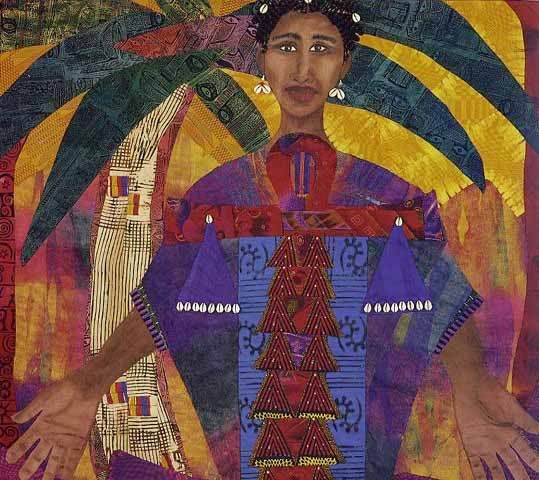
'Deborah Under The Palm Tree', Adriene Cruz

Labels: , , , ,

Saturday, December 22, 2007

If I Were Georg Friedrich Handel


If I had a gift such as Handel, I would place these passages in Isaiah in a musical setting, and listen to them sitting in front of a lighted Christmas tree with a cup of hot chocolate:


Sanctify the LORD of hosts himself; and let him be your fear, and let him be your dread. And he shall be for a sanctuary; but for a stone of stumbling and for a rock of offence to both the houses of Israel, for a gin and for a snare to the inhabitants of Jerusalem. And many among them shall stumble, and fall, and be broken, and be snared, and be taken. Bind up the testimony, seal the law among my disciples. And I will wait upon the LORD, that hideth his face from the house of Jacob, and I will look for him. (Isa 8:13-17)
This scripture reminds me that religion can often be a stone of stumbling for me, but if I will look for Christ, he can be a sanctuary and a place of saftey.

Therefore is judgment far from us, neither doth justice overtake us: we wait for light, but behold obscurity; for brightness, but we walk in darkness. We grope for the wall like the blind, and we grope as if we had no eyes: we stumble at noonday as in the night; we are in desolate places as dead men. And the LORD saw it, and it displeased him that there was no judgment. And he saw that there was no man, and wondered that there was no intercessor: therefore his arm brought SALVATION unto him; And the Redeemer shall come to Zion, and unto them that turn from transgression in Jacob, saith the LORD. (Isa 59:9,16,20)
Christ was sent into the world to dispell the darkness that often overcomes me. I relate with these verses that describe my searchings as groping for the wall as if blind. I've also felt the darkness of the soul that Isaiah describes.

Yea, in the way of thy judgments, O LORD, have we waited for thee; the desire of our soul is to thy name, and to the remembrance of thee. With my soul have I desired thee in the night; yea, with my spirit within me will I seek thee early: for when thy judgments are in the earth, the inhabitants of the world will learn righteousness. Lord, thou wilt ordain peace for us: for thou also hast wrought all thy works in us. (Isa 26:8,9,12)
This scripture is for those who yearn for something in the night which they cannot name--may the Lord ordain peace to us in this season.

In that day shall this song be sung in the land of Judah; We have a strong city; SALVATION will God appoint for walls and bulwarks. Thou wilt keep him in perfect peace, whose mind is stayed on thee: because he trusteth in thee. Trust ye in the LORD for ever: for in the LORD JEHOVAH is everlasting strength. (Isa 26:1,3,4)
This is the song I have in my heart when my faith and confidence are strong and whole. Though I stray and I complain and fret, deep inside there is a conviction that Jehovah is everlasting strength!

Neither let the son of the stranger, that hath joined himself to the LORD, speak, saying, The LORD hath utterly separated me from his people: neither let the eunuch say, Behold, I am a dry tree. For thus saith the LORD unto the eunuchs that keep my sabbaths, and choose the things that please me, and take hold of my covenant; Even unto them will I give in mine house and within my walls a place and a name better than of sons and of daughters: I will give them an everlasting name, that shall not be cut off. Even them will I bring to my holy mountain, and make them joyful in my house of prayer: their burnt offerings and their sacrifices shall be accepted upon mine altar; for mine house shall be called an house of prayer for all people. The Lord GOD which gathereth the outcasts of Israel saith, Yet will I gather others to him, beside those that are gathered unto him. (Isa 56:4,5,7,8)
I would love to make this the most beautiful song of all. It is to all those who feel they are different, who are outcasts, who need the love that God has to offer. He reaches out to us and gathers us into his holy presence.


For the people shall dwell in Zion at Jerusalem: thou shalt weep no more: he will be very gracious unto thee at the voice of thy cry; when he shall hear it, he will answer thee. And though the Lord give you the bread of adversity, and the water of affliction, yet shall not thy Teacher be removed into a corner any more, but thine eyes shall see thy Teacher: And thine ears shall hear a word behind thee, saying, This is the way, walk ye in it, when ye turn to the right hand, and when ye turn to the left. Moreover the light of the moon shall be as the light of the sun, and the light of the sun shall be sevenfold, as the light of seven days, in the day that the LORD bindeth up the breach of his people, and healeth the stroke of their wound. Ye shall have a song, as in the night when a holy solemnity is kept; and gladness of heart, as when one goeth with a pipe to come into the mountain of the LORD, to the mighty One of Israel.
I pray that in this season my eyes will be opened to see the great Teacher. I wish for the light of the sun to come into my soul. I want it to heal, to bind the breach, to bring peace and the song of gladness. Happy Christmas, my bloggy friends.

Labels: , ,

Tuesday, December 11, 2007

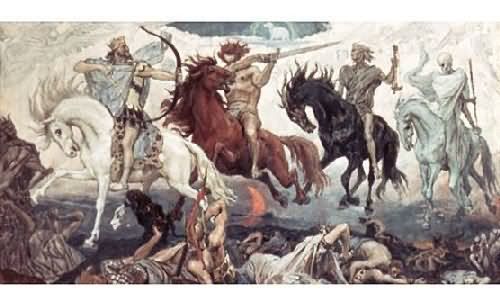
The Four Horsemen of the Apocalypse


And I saw when the Lamb opened one of the seals, and I heard, as it were the noise of thunder, one of the four beasts saying, Come and see. And I saw, and behold a white horse: and he that sat on him had a bow; and a crown was given unto him: and he went forth conquering, and to conquer. And when he had opened the second seal, I heard the second beast say, Come and see. And there went out another horse that was red: and power was given to him that sat thereon to take peace from the earth, and that they should kill one another: and there was given unto him a great sword. And when he had opened the third seal, I heard the third beast say, Come and see. And I beheld, and lo a black horse; and he that sat on him had a pair of balances in his hand. And I heard a voice in the midst of the four beasts say, A measure of wheat for a penny, and three measures of barley for a penny; and see thou hurt not the oil and the wine. And when he had opened the fourth seal, I heard the voice of the fourth beast say, Come and see. And I looked, and behold a pale horse: and his name that sat on him was Death, and Hell followed with him. And power was given unto them over the fourth part of the earth, to kill with sword, and with hunger, and with death, and with the beasts of the earth.


I couldn't live another day without finding out what the Four Horsemen of the Apocalypse were supposed to represent. Sunday School class was no help at all. The white horse was confusing me. I didn't want to believe he was representative of a punishment, or an AntiChrist, or even unrighteous dominion. It seemed to me that white was symbolic of goodness and purity. But then, how did this horseman fit with the others? My own wisdom was not sufficient. I used Google, and read many interpretations which I could not quite accept. I tried prayer, and was impatiently waiting for a dream, a vision, or a voice in my head, when I remembered a quote from Joseph Smith about understanding the symbols in the scriptures. I looked it up, and here it is in it's entirety:
"I make this broad declaration, that whenever God gives a vision of an image, or beast, or figure of any kind, He always holds Himself responsible to give a revelation or interpretation of the meaning thereof, otherwise we are not responsible or accountable for our belief in it. Don't be afraid of being damned for not knowing the meaning of a vision or figure, if God has not given a revelation or interpretation of the subject." (Teachings of the Prophet Joseph Smith, p. 291.)

I decided to look for a scriptural interpretation of the meaning. Perhaps God had given the meaning to this symbolic passage. My first stop was D&C 77, which is a series of answers to questions about Revelation. It didn't seem to help much, but it did clarify that "the first seal contains the things of the first thousand years, and the second also of the second thousand years, and so on until the seventh." I saw that the four horsemen were associated with the opening of the first four seals.

My next big break happened as I read a little further in Revelation and noticed this description:

Rev 14:14--And I looked, and behold a white cloud, and upon the cloud one sat like unto the Son of man, having on his head a golden crown, and in his hand a sharp sickle.
Then Revelation 19:11-12--And I saw heaven opened, and behold a white horse; and he that sat upon him was called Faithful and True, and in righteousness he doth judge and make war. His eyes were as a flame of fire, and on his head were many crowns; and he had a name written, that no man knew, but he himself.

There it was! The same scriptural symbols--a white horse, a crown, a conquerer--were used to represent Christ. I was vindicated. But I still didn't know why Christ was included in this particular set of four. He didn't seem to fit with the others.

More searching in the scriptures brought me to the obscure book of Zechariah. Did you know that the same four colored horses are mentioned in chapters 1 and 6? News to me. Zechariah even had the presence of mind to ask what these horses meant; and the angel answered that they were "they whom the Lord hath sent to walk to and fro through the earth." Prophets! I realized. Then it became clear to me that the horses were symbols of prophets who were sent to preside over the unveiling of Christ at the opening of each of the seals, or in the thousand year dispensations.

That would make Christ the horseman on each of the horses. I took yet another look to see if I could recognize Christ in these riders. The first was simple: a rider with a bow and a crown who went forth to conquer. The second horseman was sitting on a red horse. The red could represent the blood of Christ. This horseman had power to take peace from the earth. Sounded like Christ's words in Matthew 10:34. The rider of the red horse also had a sword. As I turned back to the rider in Revelation 19 I read: "And he was clothed with a vesture dipped in blood: and his name is called The Word of God. And out of his mouth goeth a sharp sword, that with it he should smite the nations: and he shall rule them with a rod of iron: and he treadeth the winepress of the fierceness and wrath of Almighty God. And he hath on his vesture and on his thigh a name written, KING OF KINGS, AND LORD OF LORDS." This perfectly described the second rider, and identified him with Christ.

The next rider had been identified by many scriptural scholars as "Famine," and this interpretation seemed to fit so well that at first it was hard to see how it might represent the Savior. However, the scales he had in his hands could also represent judgment, and the famine could be a spiritual famine; a hunger for the "Word of God," or Christ. Reading again in Revelation 19 revealed that the horseman "in righteousness he doth judge..."

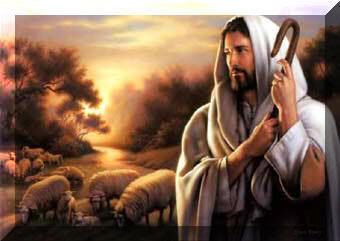
The final rider had a name: Death. And Hell followed with him. So how did this horseman represent Christ? As I read about how power was given to them to kill with sword, hunger, death, and beasts, I recognized a connection with the rider of Revelation 19 who made war with the kings of the earth, slaying them with the sword and filling the mouths of the fowls with their flesh. This Messiah image, though not as comfortable to us as the loving Good Shepherd, is nonetheless an important scriptural aspect of his reign.

And so this week I have become acquainted with the four horsemen of the Apocalypse--all representative of Christ. This Messiah is revealed to the peoples of the earth by prophets, or the four different colored horses. And if you have made it through this post, you are ready for next week's Sunday School lesson, since my ward is a little bit ahead. I'd love to hear how your Sunday School teacher spins this chapter! Send me a comment.

Labels: , ,

Thursday, October 04, 2007

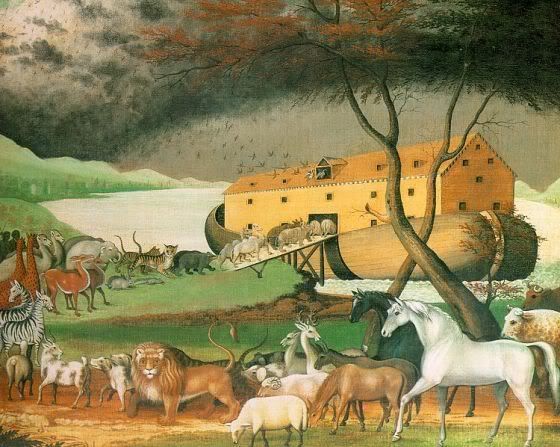
Latter-Day Saints Grapple With the Noachian Flood--A Dialogue Review


LDS discussions of Noah and the Flood are fascinating. We are uniquely qualified among religions to debate this subject. On the one hand, acceptance of science as a means to discover truth has a long-standing tradition among Mormons. Brigham Young is quoted thus:
"How gladly would we understand every principle pertaining to science and art, and become thoroughly acquainted with every intricate operation of nature."
On the other hand, Latter-Day revelation confirms the existence of an historical Flood and the reality of the person Noah. As a faith tradition, we often receive mixed signals from our leaders, who are not unified on their interpretation of this Biblical story. Since there is no official and dogmatic position on the historical occurrence of a worldwide Flood, we see much variance among faithful members. Some of the discussions I have enjoyed on this topic are

Duane E. Jeffrey, Noah's Flood: Modern Scholarship and Mormon Traditions, Sunstone Oct 2004.

Donald W. Parry, The Flood and the Tower of Babel, Ensign, Jan 1998.

Julie M. Smith, SS Lesson #6, Times and Seasons, Jan 31, 2006.

GeoffJ, The Noah Version of the Creation Narrative (or, ark=uterus?), New Cool Thang, Feb 2, 2006.

lxxluthor, The Incoherence of the Flood, Faith Promoting Rumor, March 8, 2007

Ronan, Your Monday Poll #2, BCC, Sept 10, 2007

These discussions demonstrate just how much faithful Mormons can differ on their understanding of the Biblical narrative of the Flood. This month's Dialogue, which I have featured on my sidebar, contains yet another discussion on the topic of the Flood. "On Balancing Faith in Mormonism with Traditional Biblical Stories: The Noachian Flood Story" by Clayton M. White and Mark D. Thomas is available online at the Dialogue website. White and Thomas assert that there exist several groups of thought among Latter-Day Saints concerning the Noachian Flood:
1. Many members assume that their religion requires them to believe in the Flood as a world-wide occurrence.
2. A sizable group of LDS believe that the Flood story reports a local event.
3. A third group of believing Saints hold that the story is fictional, but valuable as symbolic and containing moral principles.

The bulk of this article seems dedicated to presenting the scientific evidence against a worldwide Flood. While giving lip service to "room for competent opposing opinions," it seems to me that the authors place their credence in an actual, yet localized Flood. The article does a creditable job presenting scientific evidence against a worldwide Flood in a nutshell. The article is readable and concise. It covers the following salient points:

Insufficient size of the Ark to contain sufficient species for the enormous global biodiversity we see today.

Insufficient time to acquire animals from all land masses on Earth

Impossibility of maintaining specialized conditions required for maintenance of fragile species

Lack of evidence that species on islands and continental land masses arrived there from a single point source.

Complications of requirements of marine vs. fresh-water aquatic species

Discussion of problems relating to parasites and microorganisms.

Fossil records of endemic species and/or groups.

Evidences of tree growth rings

Difficulties of transporting entire ecological systems.

Global distribution of life and it's incompatibiliy with repopulation from a single focal point.

Although these several points were well-presented, I felt the article lacked the balance called for by its thesis. There are many unique reasons that a large group of Latter-Day Saints believe in a literal worldwide flood. Some of these could include the reality of Noah in LDS doctrine, the necessity of the "baptism of the earth," and the location of the Garden of Eden in Missouri necessitating a means of transporting the covenant people to the Middle East. There are undoubtedly other strong reasons for a belief in an historical Deluge.


Lack of consideration of these points leads to the veiled condescension which I detected in this article toward those who reject the authors' conclusions. In spite of the authors' assertion that "our aim in this article is to assess the competing claims regarding the historical core of the biblical story of Noah's flood," in fact only one of the three competing claims was thoroughly treated.

Notwithstanding that I share the perspective presented by the authors, I regret that more space was not given to the exploration of the strong bases upon which proponents of other explanations of the Flood stand.

I can agree most wholeheartedly with the authors' conclusion that
"As we seriously explore the historical core of the story of Noah's ark and the flood, we are likely to encounter several possible temptations at odds with John Taylor's open quest for truth, cited in the opening of this paper. These temptations are to abandon either the text, science, or religion in our quest for truth about the story of Noah."
The article is worth reading for its concluding plea to abandon neither science nor religion in grappling with the ambiguity of this powerful Biblical piece of literature.


Additional reviews of this Dialogue article can be seen at T&S, NDBF, LDS Science Review, Adventures in Mormonism.

Labels: , , ,

Wednesday, February 14, 2007

Biblical Knowledge Quiz

You know the Bible 100%!

Wow! You are awesome! You are a true Biblical scholar, not just a hearer but a personal reader! The books, the characters, the events, the verses - you know it all! You are fantastic!

Ultimate Bible Quiz
Create MySpace Quizzes


(Don't I just wish I knew the Bible 100%!!)

But I can answer 42 questions like this:

35. In Jesus' parable, who stopped to help a man in need?
Donald Trump
Donald Duck
Don Knotts
a Samaritan

Labels: ,

Wednesday, January 31, 2007

Misquoting Jesus Chapter 4

The most significant thought I absorbed from the reading of the book Misquoting Jesus was not stated overtly in Chapter 4, but once I learned this principle it permeated the rest of my reading. Bart Ehrman suggests throughout this work that the writers of the Christian books of scripture each have their own perpectives and valuable things to teach us. Textual criticism can bring us closer to the actual words of the authors and help reconstruct their understanding of the Christian faith. (p.14) Previous to my reading this book I approached the New Testament with a "harmonization" tactic, attempting to fit the ideas of the different authors into a cohesive whole. With Ehrman's instruction I see the value of taking each writer on his own terms and discovering their intent in writing. For example, Luke wishes to present Jesus as full of confidence in his divine mission, never losing control, never in anguish over his fate. (p. 143) This portrayal will necessarily conflict with an author such as Mark, who focuses attention on Jesus' agony. Mark emphasizes Jesus' distress and agitation at Gethsemane, his thrice-repeated prayer for the cup to be removed, and his despair on the cross. (p. 142)
Understanding this paradigm opens one up to studying the writers of the New Testament books with a deeper understanding. Their themes and motivations become more clear despite mistakes in transmission and the changes of scribes to try to harmonize the accounts and clarify the doctrine.

Chapter 4 discusses textual variations in detail. Several conclusions can be drawn from the fact that so many textual differences exist. Ehrman mentions three main conclusions drawn from a faith-based perspective:

1. From the tradition of Richard Simon, a French Catholic author: the Christian faith can not be based solely on scripture but requires the apostolic tradition preserved in the (Catholic) Church. (p. 102)

2 From Daniel Whitby's response to Mill's Apparatus: Errors are a result of the frailties of men, but "God would never allow the text to be corrupted to the point that it could not adequately achieve its divine aim and purpose." (p. 85)

3. Errors exist but textual criticism enables modern scholars to reconstruct the original words, so the foundation of faith is secured. A corollary to this view is that errors exist because of he multiplicity of manuscripts, but variations actually help us to discover more correct readings. (p. 105)

I am interested in these three faith-based perspectives, especially with respect to how the LDS church responds to textual variation. There is no attempt by Mormon writers to deny the existence of variation. The 8th Article of Faith states that we believe the Bible "as far as it is translated correctly," with an understanding that much of it has not been transmitted in it's original form. I've seen conclusions #1 and #2 above promulgated in LDS thought. Although we recognize errors in the scriptures, they are not so dire as to lead members away from salvation. Additionally, the Church has an apostolic tradition which will correct deviations which its membership needs to be aware of.

Besides the example of Joseph Smith, I have not seen any attempt by the Church to embrace textual criticism as a method of reconstructing the original autographs of Biblical authors. (Conclusion #3 above) Joseph did do some work in "reconstructing" texts, mainly by revelation and his understanding of what the texts meant to convey. But since that time I have seen little interest by LDS scholars to utilize textual criticism. Mogget's recent post on LDS Biblical scholarship is a point in fact.

Perhaps some of the others following this book discussion might wish to speculate whether the LDS Church might be able to benefit from textual criticism or what holds them back from doing so. (See also this review, which discusses further aspects important to Chapter 4.)

Labels: ,

Friday, September 22, 2006

Singing the Song of Songs


I was disappointed when we skipped the Song of Solomon last week in Gospel Doctrine. Of course, I wasn’t surprised. As we study the Old Testament every four years, if the book is even mentioned, it is to summarily dismiss it with the notation in the Joseph Smith Translation that the Songs of Solomon are not inspired writings, and thus do not belong in the Biblical canon. Nonetheless, the Song seems to me to have some commonality with the D&C and deserves a closer look.

I first noticed a similarity in language between Solomon’s Song and the D&C when I came across these words, “Who is she that looketh forth as the morning, fair as the moon, clear as the sun, and terrible as an army with banners?” This verse comes from Song 6:10 and describes Solomon’s Shulamite princess to whom his song of love is directed. To D&C scholars these words call to mind Section 5:14 and 109:73 where the Church comes forth from the wilderness of darkness “fair as the moon, clear as the sun, and terrible as an army with banners.” I’m not the first to blog about this similarity. But to me, the appearance of these verses in the D&C gives credence to the view held by some Christian theologians that Solomon’s love song to the Shulamite is an allegory or type of Christ’s relationship to the Church. Solomon is not the only one to use this poetic form. Jeremiah tells his readers, “I have likened the daughter of Zion to a comely and delicate woman.” (Jer. 6:2) In Isaiah and Jeremiah the “daughter of Zion” is a figure meaning “the covenant people.” Thus Jeremiah, Isaiah, Solomon, and others liken the Church to a beautiful woman.

In my view, the Latter-day Saints, with the interpretation of this allegory plainly stated in the D&C, are uniquely placed to understand and appreciate the Song of Solomon. Many images which appear within the verses seem fruitful for further study. For example, a familiarity with the Old Testament Temple calls this edifice to mind while reading these verses from the Song:

King Solomon made himself a chariot of the wood of Lebanon. He made the pillars thereof of silver, the bottom thereof of gold, the covering of it purple, the midst thereof being paved with love, for the daughters of Jerusalem. (Song 3:9-10)

Here we see the Temple as a chariot, built to bring the covenant people into the presence of Deity. Other interesting images found in the Song include fruit that is sweet to the taste, the adornment of the bride, the banquet, the fig tree, the vineyard, frankincense and myrrh, seeking, washing of the feet, the entreaty to “return,” and the “sealing” of love. These themes are repeated often enough in other, more acceptable scriptural passages that it is difficult to understand why they have been neglected and rejected by Latter-day Saints.

Mormons seem to find it uncomfortable to uncover a celebration of sexuality in the scriptures. They hesitate to compare these images of love to their chaste conception of Christ’s love for his Bride. This may have as much to do with our dismissal of this unusual book as the note in the JST. But to me the Song is a spiritual enticement. It seems to call to me with the voice of an ardent suitor. I place the Savior in the role of the beloved lover in the Song and thrill to these words: “I sleep, but my heart waketh: it is the voice of my beloved that knocketh, saying, Open to me…”

Labels: ,