Friday, March 07, 2008

The Doctrine of Elias, Elijah, and Christ

My stats for the past few days show that there is not a whole lot of interest in the subject of Elias! But I'm still into it, so here I go again.

My eye was drawn to the subheading on page 85 of the JS manual, which reads, A person who has the spirit of Elias has a preparatory work assigned to him by the Lord. Now, we Mormons often apply the title "Elias" to John the Baptist, as is done here in the manual. And Joseph Smith taught that his own ordination under the hand of John the Baptist constituted the Spirit of Elias. But we don't generally apply this title to anyone else. This subheading in the manual suggests that anyone who undertakes a preparatory work in a gospel context has the Spirit of Elias. I wondered if these words were really representative of what Joseph was teaching. So I went to the full text of Joseph Smith's March 10, 1844 discourse, which can be found here. The sermon was delivered on the Nauvoo temple grounds and was reported in several different sources: the Wilford Woodruff journal, James Burgess notebook, Franklin D. Richards "Scriptural Items," Joseph Smith diary (Willard Richards), Thomas Bullock diary and the John S. Fullmer papers. The version in the JS manual comes from Wilford Woodruff, who recorded it in the greatest detail.

The subject of Joseph's talk was to show the differences between the work, spirit, and calling of Elias, Elijah, and Messiah. Joseph describes the spirit of Elias as being a preparatory work, and gives the example of John the Baptist. The Baptist's mission was a true representation of the spirit of Elias, because it was a "going before" of another important work. [1]

After perusing the discourse, I decided that the manual was justified in giving the doctrine of Elias a wider application than I had previously supposed. Joseph said that "it was called the doctrin of Elias even from the early ages of the world" and applied to Aaron, John, Philip, and others. Joseph also told his audience that it is necessary to know who holds the keys of power and who does not, or we are likely to be deceived. A scriptural example is given wherein Joseph gives a unique exegesis of Acts 19:
Paul when he came to Corinth found certain disciples and asked them if they had received the holy ghost since they bleived, and they said we have not so much as heard of the holy ghost and with what surprise says he unto them. unto what were you babtised and they said unto Johns baptism. not so not so my friends if you had you would have heard of the holy ghost but you have been duped by some designing knave who has come in the name of John an imposture. how do you know it Paul? why John verilly babtised with water unto repentance, always telling the people that they should beleive on him that should come after him. he would babtise with fire and with the holy ghost.

Thus those who were doing a preparatory work would not transcend their bounds and would clearly point the way toward the greater work they were sent to advance. Joseph felt that it was important for his audience to know how to distinguish who had the Priesthood of Elias, for "when any man comes among you saying I have the spirit of Elias you can know whether he be true or fals." It sounds as if Joseph was expecting many men to come along claiming the Spirit of Elias!

Perhaps we as a Latter-day Church should be exhibiting more of the spirit of the Elias than we presently realize.

Not included in the manual, but vital to understanding the doctrine of Elias are the spirit, power, and calling of Elijah and Messiah, which Joseph next expounds:
...the spirit power & calling of Elijah is that ye have power to hold the keys of the revelations ordinances, oricles powers & endowments of the fulness of the Melchezedek Priesthood & of the Kingdom of God on the Earth & to receive, obtain & perform all the ordinances belonging to the Kingdom of God even unto the sealing of the hearts of the hearts fathers unto the children & the hearts of the children unto the fathers...

Joseph told his LDS listeners that they were to use the power of Elijah to redeem their dead and to connect themselves with their fathers. The sealing power was used a bit differently in the early days of the Church to form connections between priesthood holders. In this discourse, we can see Joseph's understanding of this sealing power. He tells the brethren to have their sons and daughters sealed to them first, and then seal themselves to their fathers. They should be "crafty" and seal all they can on earth, and these sealings would be in force in the heavens.[2] In this way, the Spirit of Elijah is used to make their calling and election sure.

(In his sermon, Joseph also makes it clear that the power of Elijah may be used by a righteous priesthood holder to seal his enemies or the unrighteous up to the damnation of Hell!)

Finally, the doctrine of Messiah was mentioned. Elias would prepare the way, Elijah would build up the kingdom, and then Messiah would come to his temple. "The Spirit of Messiah is all power in Heaven and in Earth--" Joseph said--"Enthroned in the Heavens as King of Kings and Lord of Lords." Then he ended his sermon with a promise to treat upon the Spirit of Messiah at some future time.

It seems to me that Joseph's purpose in preaching the doctrine of Elias, Elijah, and Messiah was to show his people how to participate themselves in the spirit and calling of the work. I think that a teacher who is well-versed in the teachings of Joseph on this subject might rightly emphasize the spirit of Elias as it relates not only to John the Baptist and to Joseph Smith, but to individual priesthood holders in the classroom.

Now, I'd like to address my final thoughts to how this relates to women, since 50% of those who will hear this lesson in the coming weeks will be female. Joseph had an audience consisting of many women, yet he seemed to address his remarks mainly to Priesthood holders. I often wonder how much he intended to include women in this group, since he may have considered temple-endowed women who were married to priesthood holders as participants in that priesthood. [3] Be that as it may, the discussion on pages 86 and 87 of the manual quite glaringly leaves women out of any direct involvement in the administration of the Gospel and the spirit of Elias. However, perhaps there is precedent for inclusion. Often, when we speak of the spirit of Elijah, we refer to genealogy and temple work and encourage women to be earnestly involved in this work. In the same manner, might we not sanction the participation of females in the work of Elias? Women can effectively prepare the way for the coming of the Messiah in much of their family and Church service.

_____________________________________________


[1] As an aside, Woodruff quotes Joseph saying, "John the Baptist he Came balling through the wilderness prepare ye the way of the Lord." The Burgess version recounts, "he came bounding out of the wilderness saying repent ye for the kingdom of heaven is come unto you." I think it is possible that Joseph was using the word, "bawling." The quote as it appears cleaned up in our manual is, "He came crying through the wilderness, 'Prepare ye the way of the Lord...'"

[2] This advice led to the practice of the law of adoption, whereby a man could have any number of men adopted to himself as his sons for eternity. For example, in June, 1896, Wilford Woodruff gave a synopsis of his work in the ministry since 1834: "I officiated in Adopting 96 Men to Men." (Wilford Woodruff's Journal, 1833-1898, typescript, edited by Scott G. Kenney, 1985, Vol. 9, page 408) In another synopsis for the years 1834-1885, he revealed: "I had 45 Persons Adopted to me." (Ibid., Vol. 8, page 352) Utah historian Hubert Howe Bancroft gave this information about the law of adoption: "The father may be either younger or older than the son, but in any case assumes the character of guardian, with full control of the labor and estate of the adopted son. Many young men give themselves over to the leaders as 'eternal sons,' in the hope of sharing the honor of their adopted parents." (History of Utah, page 361)

[3] For example, Joseph Smith to the Relief Society on 28 Apr 1842 “gave a lecture on the priesthood shewing how the Sisters would come in possession of the privileges & blessings & gifts of the priesthood & that these signs should follow them, such as healing the sick, casting out devils &c. & that they might attain unto these blessings….” (Book of the Law of the Lord, (Joseph Smith’s journal) 28 April 1842; also in Dean Jesse, ed “The Papers of Joseph Smith, Vol 2, 378-79.)

Also: “…What was the power of Melchizedek? ‘Twas not the Priesthood of Aaron which administers in outward ordinances, and the offering of sacrifices. Those holding the fulness of the Melchizedek Priesthood are kings and priests (or “Queens and Priestesses“) of the Most High God, holding the keys of power and blessings.” (Joseph Smith, TPJS, 322)

*

Labels: , , , ,

Wednesday, March 05, 2008

Elias in the JS Manual #6

A perusal of upcoming Lesson #6 in the Joseph Smith manual had me revisiting my notes on Elias. Thus far LDS thought has identified 4 uses of "Elias," but even with these many explanations, there are many holes and questions left in our understanding of this doctrine.


First, a review of the meanings of "Elias:"

Elias the Greek form of Elijah

Elias in the NT is simply the Greek form of the OT Hebrew name Elijah, meaning "YHWH is my God." When אליהו (Elijah) is transliterated into Greek it becomes Ἠλίας (Elias).

  1. James 5:17—-Elias/Elijah had power over rain (see 1 Kings 17:1, 18:1)
  2. Luke 4:25-26—-Elias/Elijah sent to widow woman of Zarepta (see 1 Kings 17:9)
  3. Rom. 11: 2-4—-Elias/Elijah makes intercession to God against Israel (see 1 Kgs. 19:10-18)

Elias the Preparer

  1. John the Baptist—-The JST identifies John as "an Elias," because he prepared the way for Christ, the Elias who was to come and restore all things. See JST Mark 9:3-4, JST Matt 11:13-14, JST John 1:19-28, BD. The D&C states that John would be filled with the Spirit of Elias. (D&C 27:7)
  2. Joseph Smith—-Joseph named himself as an Elias: "...my ordination [to the AP] was a preparatory work, or a going before, which was the Spirit of Elias; for the Spirit of Elias was a going before to prepare the way for the greater, which was the case with John the Baptist."
  3. Adam--"In his physical-spiritual state in Eden, Adam was called the "first man" (Moses 1:34) and given responsibility to dress the garden and "open the way of the world" (TPJS, p. 12). As the first on this earth to receive priesthood keys, Adam continues to dispense authority to others and to watch over priesthood administration on the earth.

Elias the Restorer

  1. Jesus--(JST John 1:20-28) John the Baptist testifies that Christ was the Elias who was to restore all things.
  2. Joseph Smith--(D&C 77:9, with D&C 110:11-13. See also Rev 7:2)
  3. John the Revelator--(D&C 77:14)
  4. Moroni—-Book of Mormon prophet, returned to earth as a resurrected being and prepared Joseph Smith to receive and translate the gold plates. His role was to restore the everlasting gospel to be preached to all the world.
  5. Gabriel/Noah--In D&C 27:5-13 Elias, who holds the keys of restoration, will be one of the company present at a special sacrament service with Christ at his 2nd coming. This Elias visited Zachariah in angelic form and told him he would have a son. We know from Luke 1:11-19 that this angel was Gabriel. Joseph Smith once said that the angel Gabriel was Noah.

Elias the Prophet

  • In D&C 110:11-13 Elias appears as part of the company who committed keys at the Kirtland Temple. BD says this is an unknown prophet from the time of Abraham.

Questions

~Who appeared on the Mount of Transfiguration?
In the NT accounts in Luke 9:28-35; Matt 17:1-12; Mark 9:2-13 Moses and Elias appear on the Mount of Transfiguration. Elias here is traditionally understood to be the OT prophet Elijah. The JST of Mark 9:3 reads “and there appeared unto them Elias with Moses, or in other words, John the Baptist and Moses…” The BD seeks to clarify this statement by explaining, "The curious wording of JST Mark 9: 3 does not imply that the Elias at the Transfiguration was John the Baptist, but that in addition to Elijah the prophet, John the Baptist was present." This actually causes more problems. Luke 9:30 specifies that only two personages appeared, not three: “there talked with him two men, which were Moses and Elias.” Also, Peter suggests making three tabernacles, one for Jesus, one for Moses, and one for Elias. (Luke 9:33, Matt 17:4, Mark 9:5) A fourth tabernacle for John the Baptist is not mentioned. I am willing to entertain the thought that the BD is simply wrong, and that there were only two personages involved. Whether "Elias" was Elijah or John the Baptist is less certain. Elijah and Moses are often linked in scripture. However, some have said that the two prophets represent the Aaronic and the Melchizedek Priesthoods. If this is true, John the Baptist might make a better fit than Elijah as the representative of the AP.

~Is the “Elias” mentioned in D&C 138 John the Baptist, or Elijah?In D&C 138:45 Elias is part of the company of the righteous commissioned to preach the gospel to the dead in the Spirit World. He is specified as the Elias who was with Moses on the Mount of Transfiguration. The company consists of Adam, Eve, Abel, Seth, Noah, Shem, Abraham, Isaac, Jacob, Moses, Isaiah, Ezekiel, Daniel, Elias, Malachi, (Elijah is then quoted in connection with Malachi).
This reference is not mentioned in the BD. It appears to me that Elias here refers to the prophet Elijah, since the other members of the company are all mentioned by name and are Old Testament personalities. However, the question arises, why is a different form of the name used in verse 45 and verses 46-47? Was this a way to distinguish the Baptist from the OT prophet who would restore the sealing power?

~Does the “Elias” who had the keys to the Dispensation of Abraham and is mentioned in D&C 110 refer to the prophet Elijah? Or is he a completely different OT prophet named Elias? Or is this a title meant to refer to John the Baptist, Abraham, or another forerunner? In this revelation, three prophets appear to JS and Oliver Cowdery in the Kirtland Temple to bestow keys: Moses, Elias, and Elijah. One might ask, if Elias is an OT prophet in this section, why the Greek name? Is it a title? Was it used merely to avoid confusion with the Elijah in the next verse? The BD uses this scripture as the only reference to an unknown "man called Elias [who] apparently lived in mortality in the days of Abraham." Why, as Kevin Barney has asked, would God send a man no one had ever heard of and who is nowhere mentioned in the Bible to commit the keys of the dispensation of Abraham to Joseph Smith? The whole point of bringing famous personalities from biblical antiquity to restore these keys is the fact that they were well known and their authority was assured. Once again, the BD strikes out. Kevin postulates that this Elias is John the Baptist. I think his view can be supported by the idea that John the Baptist could have held the keys to the Dispensation of Abraham. (See D&C 84:28.) This theory also works if we accept that there were 3 prophets--Moses, Elias (John the Baptist), and Elijah--present at the Mount of Transfiguration.


Well, I have more to say about Elias, but this post is getting long. So look for part 2 later. I'll include more about Lesson #6 in the JS manual. In the meantime, here are some great references:

Kevin Barney's post at BCC on the Elias of D&C 110
"...my tentative suggestion to the question is that Joseph understood the Elias of the Mount of Transfiguration, which was the model for who appeared to him at the Kirtland Temple in these verses, to be John the Baptist, a separate individual from Elijah the Tishbite."
Comment #11 by Last Lemming:
"Kevin makes the case that Joseph seems to have believed that the “Elias” at the transfiguration was John the Baptist. So why not just identify him by name? Maybe because John the Baptist was one resurrected face with which Joseph was already familiar, and it was not the face of the 'Elias' who appeared in Kirtland. So he retained the linkage of Moses with 'Elias,' but was otherwise not confident enough in the identity of 'Elias' to commit it to writing...Incidently, my vote for the restorer of the gospel of Abraham is…ahem…Abraham."

Joe Spencer's post on Elias and Elijah at FUTW
"I think the pairing of Elijah and Moses makes a great deal of sense, and I must confess I am still at a loss as to how to make any sense of the separation between Elijah and Elias. Because of D&C 110, it seems quite clear that there must be two different people here, but the common locution of making “Elias” a title doesn’t really make any sense to me."
Comment #2 by Ben McGuire:
"I think that one response is simply to suggest that D&C 110 is simply in error. That is, that Elias there is either not the name of the angelic being referred to. This could be because it was used there as a title to refer to someone else (Noah or John the Baptist or Abraham himself are the leading candidates in speculative literature), or because Joseph simply misidentified the person or the title as the name of the person."

Sam Brown, "The Prophet Elias Puzzle," in Dialogue
"Writers from within Mormonism have historically focused, with precedent in the Prophet's teachings, on a 'Spirit of Elias' borne by various angelic ministrants while positing the existence of a minor but essentially unknown prophet actually named Elias who stays away from center stage. Later writers, exemplified by Bruce R. McConkie, have described these several instances of Elias in impressive detail. These creative solutions have been a response to increduloud critics who see only a glaring error of transliteration made corporeal, a chink in the armor of Joseph Smith's seerhood...I will contextualize the prophet Elijah and attempt to solve the puzzle of Elias, investigating the linguistic evidence, exploring Joseph Smith's discussions of Elias, and providing a theoretical framework for the significance of the Elijah/Elias bifurcation."
Comment by Robert C.:
"the article takes the view that making a distinction between Elias and Elijah was, among other things, a way for Joseph Smith to make a distinction between Elijah as Prostestants of the time understood him and the new eternal-family view that Joseph was presenting."
Comment by Joe Spencer:
"Sam suggests at once that Joseph was familiar with the equivalence of Elias and Elijah and that he made a sharp distinction between them. I really like this point because it derails the simplistic “Joseph goofed” idea (Joseph was far too careful a reader of the Bible for that). But what is fascinating me the most is the connection between the JST for John 1:22 and D&C 77. I’d like to do some more thinking there. Hmm…."

Labels: , ,

Sunday, February 24, 2008

5 LDS Interpretations of the Isaiah Passages that Should Not be Perpetuated

I promised some posts on upcoming Book of Mormon Sunday School lessons. But I have to warn you, I've been in a blue funk lately. So I suspect my thoughts are neither inspiring nor fit for Sunday School consumption. But maybe it will help you know what not to say.


LDS Sunday School students will soon take a quick leap through 13 chapters of Isaiah which are quoted by Nephi in 2nd Nephi chapters 12-24. All too often, some uniquely Mormon interpretations are given to these chapters which merit a critical analysis. In this post I present five Mormonisms which I believe hinder a deeper and more accurate understanding of Isaiah's writings.

1. 2 Nephi 12:2,3 Popular LDS commentary on this verse identifies it as Isaiah's vision of people from many lands coming to Salt Lake City, Utah.

Many prophecies of Isaiah are dual and can be applied to more than one time, situation or people. I am aware that latter-day prophets and apostles have related this verse to the Salt Lake temple or even to the Conference Center from which the word of the Lord is issuing forth in these days. However, if we insist too strongly on this Mormon-centric view, we can miss the primary application which this verse has to the millennial reign of the Messiah. The word "mountain" as used in the Bible is a metaphor for "nation," "government," or "political system." In verses 2 and 3 Isaiah is speaking of the millennial condition when Christ shall establish the political Kingdom of God upon the earth. This will be established "in the top of the mountains," or in other words "as the head of the nations."

2. 2 Nephi 12:3 Isaiah wrote that the word of the Lord will come from Jerusalem, and the law will come from Zion, the New Jerusalem, located in Jackson County, Missouri. There will be two distinct centers of influence for God's people.

This may be, but verse 3 should not be used as a proof-text. Here we have a synonymous chiastic parallel where

the Law = the Word of the Lord, and
Zion = Jerusalem (one and the same)

The chiastic structure of this phrase indicates that Isaiah equated Zion with Jerusalem (the one located in Israel!) If we accept this, we will be able to learn more about Zion as it relates to the ancient City of David.

3. 2 Nephi 12:9 In the Book of Mormon, verse 9 is clarified by adding the word "not" to the following statement: "And the mean man boweth [not] down and the great man humbleth himself [not], therefore forgive him not."

This verse actually makes much more sense in its original context, without the extra "not" added in the Book of Mormon version. Verse 8 speaks of idols which are found throughout the land. And the mean (common) man and the great (important) man boweth down (to these idols). This version makes more sense coming as it does right after the description of people worshipping idols, the work of their own hands.

4. 2 Nephi 12:13-17 Some Mormons still insist that this passage is an example of the restoration in the Book of Mormon of passages that were lost in the Old Testament. As noted in footnote 16a, “The Greek (Septuagint) has ‘ships of the sea.’ The Hebrew has ‘ships of Tarshish.’ The Book of Mormon has both, showing that the brass plates had lost neither phrase.”

Pike and Seely have shown the challenges of accepting this interpretation. I love the poetry of the passage and find that the addition of the extra phrase and other interjected words spoils the beauty of the chiastic tripled bicola. Isaiah used poetic conventions frequently to emphasize his points. The Book of Mormon addition does not enhance the poetic structure of the passage, but instead inhibits it. The Greek "ships of the sea" and the Hebrew "ships of Tarshish" are probably different translations of one original phrase and it is not necessary or preferable to include both. Observe the perfection of the Masoretic text with the pattern of w- (conjunction) + al (preposition "upon") followed by kol- ("all/every") and then two words (here in English translation):
For the day of the LORD of hosts shall be

upon every one that is proud and lofty,
and upon every one that is lifted up; and he shall be brought low:


and upon all the cedars of Lebanon, that are high and lifted up,
and upon all the oaks of Bashan,


and upon all the high mountains,
and upon all the hills that are lifted up,


and upon every high tower,
and upon every fenced wall,


and upon all the ships of Tarshish,
and upon all pleasant pictures (fine craft)


and the loftiness of man shall be bowed down,
and the haughtiness of men shall be made low;


and the LORD alone shall be exalted in that day.

(if all this fascinates you, there is a well-reasoned apologetic view here. But I stand by my opinion.)

5. 2 Nephi 14:1 The Mormon speculation on this verse goes as follows: With so many men killed in war, righteous single priesthood holders are in short supply. Thus, plural marriage is reinstituted, with many women stating they will support themselves in order to receive priesthood covenant protection.

My examination of the Hebrew of this verse makes me confident in translating "one man" as "a certain man." The verse thus teaches that in the latter day seven women (symbolic number of completeness, denotes the covenant people) shall take hold of a certain man (guess who that would be?) and ask him "let us be called by thy name," which will take away their reproach (effects of atonement). In my view this verse is Messianic and has nothing whatsoever to do with polygamy.

Update: Our SS teacher gave 2 of these very interpretations while presenting the lesson! How about yours??


*

Labels: , , , , ,

Thursday, February 21, 2008

Incorporating Doctrinal Change into the Church--A Poll


Thoughts for discussion: Do you think the Church has a responsibility to explain to the members when a doctrinal change is made? Would it cause more or less confusion? Would it make the Church look bad if they admit that a doctrinal policy held in the past is no longer followed? Which option above would you be most likely to respond to as a member?

Labels: , ,

Tuesday, February 19, 2008

Evolution of Official Birth Control Teachings in the Mormon Church: From Depravity and Perversion to a Sacred Matter Between the Couple and God

It appears from comments received on my last post that some are unaware of the development of official policy of the Church regarding birth control. The purpose of this post is to clarify official teachings and to demonstrate that policy has filtered down variously in different local areas.

Since its inception in 1830, the LDS Church has maintained a positive stance toward the propogation of the human race. Due to its doctrine of premortal existence, members have been urged to welcome spirits to earth by providing them physical tabernacles. Married LDS couples today are counseled to desire children and to prayerfully decide how many they can provide for physically, emotionally, and financially. Thus, it is not always apparent that the rhetoric on having children today represents a large shift from previous policy.

Recent counsel to "decide" how many children to have presupposes that there is an accepted way to curtail the birth of children after the decided-upon number has been reached. Nowhere is it officially stated that birth control is approved. But this can be assumed by the counsel which recognizes choice in number of children. This tacit acceptance of birth control is a recent move which began tentatively in the late 1970's and did not gain momentum until the presidency of Gordon B. Hinckley.

The evidence of ancient contraceptive knowledge is impressive. A list of pre-19th century contraceptive methods include: withdrawal by the male; melting suppositories designed to form an impenetrable coating over the cervix; diaphragms, caps, or other devices inserted over the cervix and withdrawn after intercourse; intrauterine devices; douching after intercourse designed to kill or drive out the sperm; condoms; and varieties of the rhythm methods. None of these methods are new. Increased availability of mass-produced and medically sound methods of birth control was seen in the United States in the early 1800's. Modern condoms were produced in the U.S. beginning about 1830. The "womb veil," an early diaphragm, was widely used by 1860. Legislation concerning birth control began to be introduced in 1873 when Anthony Comstock pushed a bill through Congress which defined contraceptive information as obscene.

Birth control became a subject that Church leaders felt constrained to clarify, affecting as it did a doctrinal matter. I would like to emphasize that every president of the Church from Brigham Young to Spencer W. Kimball spoke strongly against birth control and unequivocally denounced the use of artificial means to stop children from coming to earth. Additionally, official statements under the auspices of the First Presidency were issued to reinforce the teaching. The following statements by the latter-day prophets are representative of their teachings on the subject:

Brigham Young
"There are multitudes of pure and holy spirits waiting to take tabernacles, now what is our duty? -- To prepare tabernacles for them; to take a course that will not tend to drive those spirits into the families of the wicked, where they will be trained in wickedness, debauchery, and every species of crime. It is the duty of every righteous man and woman to prepare tabernacles for all the spirits they can." (Brigham Young, Discourses of Brigham Young, p. 197.)

“To check the increase of our race has its advocates among the influential and powerful circles of society in our nation and in other nations. The same practice existed forty-five years ago, and various devices were used by married persons to prevent the expenses and responsibilities of a family of children, which they must have incurred had they suffered nature's laws to rule preeminent. That which was practiced then in fear and against reproving conscience, is now boldly trumpeted abroad as one of the best means of ameliorating the miseries and sorrows of humanity. Infanticide is very prevalent in our nation. It is a crime that comes within the purview of the law, and is therefore not so boldly practiced as is the other equally great crime, which, no doubt, to a great extent, prevents the necessity of infanticide. The unnatural style of living, the extensive use of narcotics, the attempts to destroy and dry up the fountains of life, are fast destroying the American element of the nation; it is passing away before the increase of the more healthy, robust, honest, and less sinful class of the people which are pouring into the country daily from the Old World. The wife of the servant man is the mother of eight or ten healthy children, while the wife of his master is the mother of one or two poor, sickly children, devoid of vitality and constitution, and, if daughters, unfit, in their turn, to be mothers, and the health and vitality which nature has denied them through the irregularities of their parents are not repaired in the least by their education.” (Brigham Young, Journal of Discourses, v. 12, pp. 120-121.)

John Taylor
"...parents are afraid to fulfill the first great law of God, "Be fruitful and multiply, and replenish the earth;" and by desperate circumstances are almost forced to the unnatural wish of not propagating their species; while, corrupted with a correspondent depravity with that which reigns among nations, they are found using suicidal measures to prevent an otherwise numerous progeny from increasing their father's misery, and inheriting his misfortunes." (John Taylor, The Government of God, Chapter 2.)

Wilford Woodruff
"As to the lesser sin of preventing conception, no general rule can be laid down, there are so many different circumstances distinguishing one case from another and such a difference in motives that each particular case has to be judged by itself and decided by the light of the Spirit. But we believe where persons sincerely repent and cease the practice, they should be permitted to enter the Church. This is not the unpardonable sin, and like other misdeeds, can be forgiven when penitence and reformation are shown." (Wilford Woodruff and Joseph F. Smith to Job Pingree, Jan. 23, 1894.)

Joseph F. Smith
“Those who have taken upon themselves the responsibility of wedded life should see to it that they do not abuse the course of nature; that they do not destroy the principle of life within them, nor violate any of the commandments of God. The command which he gave in the beginning to multiply and replenish the earth is still in force upon the children of men. Possibly no greater sin could be committed by the people who have embraced this gospel than to prevent or to destroy life in the manner indicated. We are born into the world that we may have life, and we live that we may have a fullness of joy, and if we will obtain a fullness of joy, we must obey the law of our creation and the law by which we may obtain the consummation of our righteous hopes and desires -- life eternal.” (Joseph F. Smith, Gospel Doctrine, p. 276.)

"I believe that where people undertake to curtail or prevent the birth of their children that they are going to reap the disappointment by and by. I have no hesitancy in saying it is one of the greatest crimes of this world today, this evil practice." (Joseph F. Smith, Gospel Doctrine, p. 278-279)

Heber J. Grant
“Another of the great evils of the age is race suicide. This also is not consistent with the gospel of Jesus Christ. Providing opportunity for the spirit children of our Father in Heaven to come to earth and work out their own salvation is one of our sacred privileges and obligations. We teach that among the choicest of eternal riches are children.” (Heber J. Grant, Gospel Standards, p. 154.)

George Albert Smith
"Children are a heritage from the Lord, and those who refuse the responsibility of bringing them into the world and caring for them are usually prompted by selfish motives, and the result is that they suffer the penalty of selfishness throughout eternity. There is no excuse for members of our Church adopting the custom of the world. . . We have been better taught than they." (George Albert Smith, "Birth Control," Relief Society Magazine, Feb. 1917, p. 72)

David O. McKay
“Any effort or desire on the part of a married couple to shirk the responsibility of parenthood reflects a condition of mind antagonistic to the best interests of the home, the state, and the nation. No doubt there are some worldly people who honestly limit the number of children and the family to two or three because of insufficient means to clothe and educate a large family as the parents would desire to do, but in nearly all such cases, the two or three children are no better provided for than two or three times that number would be. Such parents may be sincere, even if misguided; but in most cases the desire not to have children has its birth in vanity, passion, and selfishness. Such feelings are the seeds sown in early married life that produce a harvest of discord, suspicion, estrangement, and divorce. All such efforts, too, often tend to put the marriage relationship on a level with the panderer and the courtesan. They befoul the pure fountains of life with the slime of indulgence and sensuality. Such misguided couples are ever seeking but never finding the reality for which the heart is yearning.” (David O. McKay, Relief Society Magazine, v. 3, no. 7, July 1916)

Joseph Fielding Smith
“Those who attempt to pervert the ways of the Lord, and to prevent their offspring from coming into the world in obedience to this great command, are guilty of one of the most heinous crimes in the category. There is no promise of eternal salvation and exaltation for such as they, for by their acts they prove their unworthiness for exaltation and unfitness for a kingdom where the crowning glory is the continuation of the family union and eternal increase which have been promised to all those who obey the law of the Lord.

...it is only a matter of time before those who so strongly advocate and practice the pernicious doctrine of ‘birth control’ and the limiting of the number of children in the family, will have legislated themselves and their kind out of this mortal existence.” (Joseph Fielding Smith, Relief Society Magazine, v. 3, no. 7, July 1916.)

"Birth control is wickedness. The abuse of this holy covenant has been the primary cause for the downfall of nations. When the sacred vows of marriage are broken and the real purpose of marriage abused, as we find it so prevalent in the world today, then destruction is inevitable.

No nation can endure for any length of time, if the marriage covenants are abused and treated with contempt. The anger of the Almighty was kindled against ancient nations for their immorality. There is nothing that should be held in greater sacredness than this covenant by which the spirits of men are clothed with mortal tabernacles.

When a man and a woman are married and they agree, or covenant, to limit their offspring to two or three, and practice devices to accomplish this purpose, they are guilty of iniquity which eventually must be punished. Unfortunately this evil doctrine is being taught as a virtue by many people who consider themselves cultured and highly educated. It has even crept in among members of the Church and has been advocated in some of the classes within the Church.

It should be understood definitely that this kind of doctrine is not only not advocated by the authorities of the Church, but also is condemned by them as wickedness in the sight of the Lord." (Joseph Fielding Smith, Doctrines of Salvation, Vol. 2, Pg. 85-9

Harold B. Lee
“We declare it is a grievous sin before God to adopt restrictive measures in disobedience to God's divine command from the beginning of time to ‘multiply and replenish the earth.’ Surely those who project such measures to prevent life or to destroy life before or after birth will reap the whirlwind of God's retribution, for God will not be mocked.” (Harold B. Lee, Conference Report, October 1972, p. 63.)

Spencer W. Kimball
"I have told many groups of young people that they should not postpone their marriage until they have acquired all of their education ambitions. I have told tens of thousands of young folks that when they marry they should not wait for children until they have finished their schooling and financial desires. Marriage is basically for the family, and there should be no long delay. They should live together normally and let the children come. . ." (Spencer W. Kimball, "Marriage is Honorable," Speeches of the Year, 1973, p. 263)

"The tendency for many of our girls and many of our married women to put off or to reduce their families is not pleasing to your Heavenly Father, for He said, 'multiply and replenish the earth,' and He knew what He was doing, and any of our personal opinions don't amount to much as compared to the wisdom of God. And he said as he concluded this great effort of creation, 'And I . . .saw everything that I had made, and behold, all things which I had made were very good . . .' He stood off and looked them over. He had made no errors; He had made no mistakes; He had created man and woman for a purpose. That purpose was not fun; that purpose basically was to live together in harmony and peace and to rear children in righteousness . . ." (Spencer W. Kimball, Address to Special Interest Fireside in Tabernacle, 29 Dec. 1974, pp. 4-5)

Ezra Taft Benson
The world teaches birth control. Tragically, many of our sisters subscribe to its pills and practices when they could easily provide earthly tabernacles for more of our Father's children. We know that every spirit assigned to this earth will come, whether through us or someone else. There are couples in the Church who think they are getting along just fine with their limited families but who will someday suffer the pains of remorse when they meet the spirits that might have been part of their posterity.” (Ezra Taft Benson, Conference Report, April 1969, p. 12.)

"Young mothers and fathers, with all my heart I counsel you not to postpone having your children, being co-creators with our Father in Heaven. Do not use the reasoning of the world, such as, "We will wait until we can better afford having children, until we are more secure, until John has completed his education, until he has a better paying job, until we have a larger home, until we have obtained a few of the material conveniences," and on and on. This is the reasoning of the world and is not pleasing in the sight of God. Mothers who enjoy good health, have your children and have them early. And, husbands, always be considerate of your wives in the bearing of children. Do not curtail the number of children for personal or selfish reasons. Material possessions, social convenience, and so-called professional advantages are nothing compared to a righteous posterity. In the eternal perspective, children -- not possessions, not position, not prestige -- are our greatest jewels." ("To the Mothers in Zion," Parents' Fireside, Salt Lake City, Utah, 22 February 1987.)

“True to form, many of the people who desire to frustrate God's purposes of giving mortal tabernacles to His spirit children through worldwide birth control are the very same people who support the kinds of government that perpetuate famine. They advocate an evil to cure the results of the wickedness they support.” (Ezra Taft Benson, Teachings of Ezra Taft Benson, p. 539.)

Howard W. Hunter
“Honor your wife’s unique and divinely appointed role as a mother in Israel and her special capacity to bear and nurture children. We are under divine commandment to multiply and replenish the earth and to bring up our children and grandchildren in
light and truth (see Moses 2:28; D&C 93:40). You share, as a loving partner, the care of the children. Help her to manage and keep up your home. Help teach, train, and discipline your children” (Howard W. Hunter, Conference Report, Oct. 1994, 67; or Ensign, Nov. 1994, 50.)

The earlier statements of these latter-day prophets may have been somewhat euphemistic, but there was clearly no provision for a couple "prayerfully considering" how many children to have. These sentiments were echoed by many other Apostles and General Authorities, too numerous to list here.

There has always been a percentage of Church membership which has had difficulty with the absolute proscription of any kind of family planning. By the early 1900's, the issue of what to do when childbirth took a toll on the health of the mother was beginning to be discussed. Elder Orson F. Whitney of the Quorum of the Twelve wrote:

"The only legitimate 'birth control' is that which springs naturally from the observance of divine laws, and the use of procreative powers, not for pleasure primarily, but for race perpetuation and improvement. If this involves some self-denial on the part of the husband and father, so much the better for all concerned." (Orson F. Whitney, Relief Society Magazine 3, no. 7 (July 1916).)

In a similar statement, Joseph Fielding Smith announced that even in cases of sickness, "no prevention is legitimate except through absolute abstinence." (Joseph Fielding Smith, Improvement Era 11:959-61.)

There were several official statements which were circulated in the Church under the auspices of the First Presidency. One such statement appeared in the Relief Society Magazine in February of 1917 from the office of Joseph F. Smith, Anthon H. Lund, and Charles W. Penrose:

“Officers, members of the Relief Society, herein you have the word of the Lord, on this subject. Can anything be clearer or more emphatic? It is a very strange thing that people can believe that the Lord of Life could countenance for one moment, the refusal of his children to comply with the first commandment given to Adam and Eve. It is so easy to avoid parenthood, if people wish to do so, and that, too, innocently, even if selfishly. Men and women can remain unmarried. That is all there is to it.” (First Presidency {Joseph F. Smith, Anthon H. Lund, Charles W. Penrose}, Relief Society Magazine, v. 4, no. 2, February 1917, pp. 68-69.)

Despite these types of official Church statements, the feelings of Church members and local leaders varied from ward to ward and from stake to stake. Many members had made their own decisions about birth control. A 1935 poll of 1,159 BYU students showed that 89% believed in birth control in some form. Church leaders were aware of this and continued to warn members. In 1942 the official Church magazine, the Improvement Era, included an article entitled, "Should Birth Control Be Practiced?" In it, John A. Widtsoe made a strong case against artificial means of birth control. He warned of dire consequences accompanying the use of contraceptives:

"Since birth control roots in a species of selfishness, the spiritual life of the user of contraceptives is also weakened. Women seem to become more masculine in thought and action; men more callous and reserved; both husband and wife become more careless of each other." (John A. Widtsoe, Improvement Era, Dec 1942.)

Nonetheless, Widtsoe demonstrated an understanding that at times a mother's health might be a consideration for limiting family size. In exceptional cases he suggested, "careful recognition of the fertile and sterile periods of woman would prove effective in the great majority of cases. Recent knowledge of woman's physiology reveals the natural method for controlling birth."

When McConkie's Mormon Doctrine was published in 1958 the entry on birth control quoted from Joseph Fielding Smith, "Those who practice birth control...are running counter to the foreordained plan of the Almighty. They are in rebellion against God and are guilty of gross wickedness." (Bruce R. McConkie, Mormon Doctrine, first ed., 1958, p. 81.) For about 20 years, Mormon Doctrine remained one of the most authoritative sources most Mormons had on their bookshelves. But family size among active Latter-day Saints continued to shrink.

In 1979 a seminal article on the subject of birth control appeared in the Ensign magazine. The article was not written by a General Authority. It was composed by LDS doctor Homer Ellsworth, but its appearance in the Church's official magazine necessitated approval by Church authorities. In the article, Ellsworth gave his opinion that decisions regarding the number and spacing of children were to be made by husband and wife righteously and empathetically communicating together and seeking the inspiration of the Lord. He cited the then current counsel of the First Presidency in the General Handbook of Instructions and testified that he was inspired by this statement that "the health of the mother and the well-being of the family should be considered." The entire text of the First Presidency Statement Ellsworth referenced reads as follows:

“Presidents of Stakes, Bishops of Wards, and Presidents of Missions
Dear Brethren:
The First Presidency is being asked from time to time as to what the attitude of the Church is regarding birth control. In order that you may be informed on this subject and that you may be prepared to convey the proper information to the members of the Church under your jurisdiction, we have decided to give you the following statement:
We seriously should regret that there should exist a sentiment or feeling among any members of the Church to curtail the birth of their children. We have been commanded to multiply and replenish the earth that we may have joy and rejoicing in our posterity.

Where husband and wife enjoy health and vigor and are free from impurities that would be entailed upon their posterity, it is contrary to the teachings of the Church artificially to curtail or prevent the birth of children. We believe that those who practice birth control will reap disappointment by and by.
However, we feel that men must be considerate of their wives who bear the greater responsibility not only of bearing children, but of caring for them through childhood. To this end the mother's health and strength should be conserved and the husband's consideration for his wife is his first duty, and self control a dominant factor in all their relationships.

It is our further feeling that married couples should seek inspiration and wisdom from the Lord that they may exercise discretion in solving their marital problems, and that they may be permitted to rear their children in accordance with the teachings of the gospel.” (First Presidency {David O. McKay, Hugh B. Brown, N. Eldon Tanner}, The Church of Jesus Christ of Latter-day Saints, Office of the First Presidency, April 14, 1969.)

This letter has been called a "master of diplomacy." This is because the statement can and has been used to justify both sides of the birth control debate. Notice however, that it is made clear that artificial means of curtailing the birth of children is contrary to the Church's teachings, and that "self control" is advocated when considering the mother's health and strength to bear further children.

As can be seen in the comments to my last post, this Ensign article was hailed by members all over the Church as a signal that the Church position on birth control had relaxed. In fact, this was far from the case. Church president and prophet Ezra Taft Benson continued to make many strong statements against contraception throughout his ministry. But the tide could not be held back. Throughout the seventies and eighties, Stake Presidents and Bishops freely expressed varying views in private to their respective flocks. By the time President Gordon B. Hinckley took office, the Church's historical position regarding birth control had been largely forgotten. Since 1984, a subtle shift in rhetoric has allowed members to feel comfortable with their own prayerful decisions regarding family size:

Gordon B. Hinckley
"Of course we believe in children. The Lord has told us to multiply and replenish the earth that we might have joy in our posterity, and there is no greater joy than the joy that comes of happy children in good families. But he did not designate the number, nor has the Church. That is a sacred matter left to the couple and the Lord." (Gordon B. Hinckley, Cornerstones of a Happy Home, Satellite fireside broadcast, Jan 29, 1984, then distributed in the pamphlet of the same name)

Proclamation on the Family
The first commandment that God gave to Adam and Eve pertained to their potential for parenthood as husband and wife. We declare that God’s commandment for His children to multiply and replenish the earth remains in force. (Proclamation on the Family, Ensign, Nov 1995, 102.)

Church Handbook of Instructions
It is the privilege of married couples who are able to bear children to provide mortal bodies for the spirit children of God, whom they are then responsible to nurture and rear. The decision as to how many chldren to have and when to have them is extremely intimate and private and should be left between the couple and the Lord. Church members should not judge one another in this matter.

Married couples also should understand that sexual relations within marriage are divinely approved not only for the purpose of procreation, but also as a means of expressing love and strengthening emotional and spiritual bonds between husband and wife. (Church Handbook of Instructions, January 1999)

True To the Faith--a Church published booklet referencing a number of gospel principles:
When married couples are physically able, they have the privilege of providing mortal bodies for Heavenly Father’s spirit children. They play a part in the great plan of happiness, which permits God’s children to receive physical bodies and experience mortality.

If you are married, you and your spouse should discuss your sacred responsibility to bring children into the world and nurture them in righteousness. As you do so, consider the sanctity and meaning of life. Ponder the joy that comes when children are in the home. Consider the eternal blessings that come from having a good posterity. With a testimony of these principles, you and your spouse will be prepared to prayerfully decide how many children to have and when to have them. Such decisions are between the two of you and the Lord.

As you discuss this sacred matter, remember that sexual relations within marriage are divinely approved. While one purpose of these relations is to provide physical bodies for God’s children, another purpose is to express love for one another—to bind husband and wife together in loyalty, fidelity, consideration, and common purpose. (True to the Faith: A Gospel Reference, 2004, p. 26.)


Thus we see a subtle but important shift in the doctrinal teachings of the Church on the subject of birth control. Official statements by the Church continue to be careful in their wording. Unequivocal pronouncements such as "birth control may be used for the spacing of children" are absent from official sources, but may form counsel given by local leadership or members. At present, it is generally accepted that any Mormon couple, while encouraged to have children and create a family, may make their own inspired decisions in regards to contraception and family size.

Labels: , , , , ,

Thursday, January 10, 2008

Lament of the Lost Judges


This week in Seminary I am teaching the Book of Judges. As is customary in our OT year, the students are asked to read selected chapters from the books we are studying. The chapters they read in Judges are: 2, 3, 6, 7, 8, 13, 14, 15, 16. Does anyone see a problem with this selection? Out of 13 judges in Israel there are 6 of whom we have a substantial(?) account. Our Seminary chapters cover Othniel, Ehud, Gideon, and Samson, but leave out Deborah and Jephthah.

I was annoyed, but somehow not surprised to see that Deborah was basically ignored in the lesson materials. After many hours of studying the account of Jephthah, I must also include this story in my "Lament of the Lost Judges."

The stories of Deborah and Jephthah are problematic for LDS teachers. The student manual skims over Deborah by noting:
Judges 4–5 tells about how Israel was delivered from the bondage of their enemies under the direction of a woman named Deborah, who was both a judge and a prophetess. She prophesied that a woman would destroy the enemy’s leaders. The prophecy was fulfilled when a non-Israelite woman named Jael killed the leader of the enemy army. The people learned that if they trusted the Lord, He could deliver them. Judges 5 contains the words of a song the Israelites sang about this important event. Music can be a powerful way of praising God (see also D&C 25:12).

A sidebar in the Student Manual also includes a list of judges in which Deborah and her military commander, Barak, are listed together, erroneously creating the impression that they were some sort of co-judges. The teachers manual merely suggests: "Assign students to report on the following leaders and describe how they were unlikely heroes: Ehud, Deborah, Jael, Gideon, Jephthah." Thus, the Seminary manual allows perhaps 2-5 minutes for a student presentation on Deborah and Jephthah and no commentary whatsoever for the teacher. Compare this with a section suggested to last 15-20 minutes on the fact that Samson's parents were childless. Here the manual departs radically from the Old Testament text and preaches that the plan of happiness would be affected if Satan could influence people to stop having children.

This dearth of information leaves the LDS teacher of youth with little instruction on how to present these fascinating Biblical judges, both of whom are of especial interest to women. Most will choose to simply pass over them. Considering the prominence of these stories in the scriptural record, it would be helpful if LDS lesson materials would deal with some of the following issues:

Deborah

  • What is the Old Testament definition of a prophet and a prophetess? How does this differ and fit in with our understanding of modern prophets?

  • In what way did a woman judge add to our understanding of the period of Biblical judges?

  • What special abilities did Deborah bring to her ministry?

  • Why was Deborah's authority over a military commander and her authority to provide judgment in the people's affairs unusual for her day? How did she attain such prominence?

  • In what ways were Deborah and Jael (the other important woman in the story) called of God and in what ways did they simply step up to fulfill a need that they saw?

  • What importance does the Song of Deborah have in the scriptural record?

  • How is Deborah a role model for both men and women?

  • What types of Christ do we see in Deborah's story?


I would like to ask my readers if they have heard the story of Deborah taught in an LDS setting, and if so, what was taught and how was it done? I plan to cover the story of Jephthah in greater depth, so I am saving it for my next post.


'Deborah Under The Palm Tree', Adriene Cruz

Labels: , , , ,

Friday, January 04, 2008

Beyond James 1:5


We have a tendency to speak of James 1:5 as if it were the only scripture Joseph Smith ever read. Mormons believe it is THE scripture that sent the young 14-year-old into the woods to pray. Joe Spencer in his review of "The First Vision" chapter of the new JS manual says that in his religious searches Joseph became affected by the public discourse but that his reading of James 1:5 brought him to the more important personal experience.
Joseph’s relation to the text, then, was unique: he had discovered a scripture that was generic enough (from an “epistle of straw,” as Luther put it, and his point was precisely that James was not partisan enough) that it genuinely excepted itself from the public dialogue. Joseph was leaving the public realm entirely, wagering something in a venture that would, as he would soon see, force the situation to change entirely. Joseph’s wager, interestingly enough, was a serious faithfulness or fidelity to the text, to the scripture. One could even say that he was about to stage the scripture, to enact it as if it were a script. This staging, it is clear from the last words of the text, already quoted above, changed the situation by introducing a truth: “I had found the testimony of James to be true….”

Now, I want to backpedal a bit by saying that Joe Spencer's intention in his post is to present a "serious look at the Pearl of Great Price account as quoted in the manual," without bringing in the other accounts of the First Vision. And I certainly don't wish to downplay the importance of James 1:5 in preparing Joseph Smith to ask of God. However, I feel that without a familarity of all of the extant accounts of Joseph Smith's vision, our understanding of this event will remain limited.

Joseph's retreat to the woods was more than a sudden reaction to just one scripture. In the 1832 account from the Joseph Smith Letterbook, Joseph presents himself as a serious scholar of the scriptures from the age of twelve to fifteen. He said that he applied himself to the scriptures and had an "intimate aquaintance" with the different denominations. Through his study he became convicted of his sins and realized that an apostasy had occurred, leaving no denomination built on the gospel of Jesus Christ. This understanding already leaves him with two motivations for an encounter with Deity:

1.) to rectify his standing before the Lord, and
2.) to determine which church, if any, was authorized by God.

Visionary accounts of Joseph Smith's time describe those who are convinced of their sins and go to the Lord in a search for forgiveness. These were published in local news sources. Joseph would have been well acquainted with these stories and their claims of encounters with Christ. Even without his transformational experience with James 1:5 he would have been aware of the possibility of searching for and experiencing the presence of God.

This same 1832 handwritten account shows Joseph's immersion in scriptural references and the religious rhetoric of the day. It seems that quite a few scriptures and ideas played a part in leading him to the Grove. However, James 1:5 is not specifically mentioned in this account:
"I felt to mourn for my own Sins and for the Sins of the world for I learned in the Scriptures that God was the same yesterday to day and forever that he was no respecter to persons for he was God...and when I considered upon these things my heart exclaimed well hath the wise man said the (it is a) fool (that) saith in his heart there is no God my heart exclaimed all all these bear testimony and bespeak an omnipotant and omnipreasant power a being who makith Laws and decreeeth and bindeth all things in their bounds who filleth Eternity who was and is and will be from all Eternity to Eternity and when I considered all these things and that (that) being seeketh such to worship him as worship him in spirit and in truth therefore I cried unto the Lord for mercy for there was none else to whom I could go and to obtain mercy and the Lord heard my cry..."

The 1834-5 account written by Oliver Cowdery and published in the Messenger and Advocate presents Joseph's vision as a response to the religious excitement in Palmyra and a desire for forgiveness of his sins.
"And it is only necessary for me to say, that while this excitement continued, [Joseph] continued to call upon the Lord in secret for a full manifestation of divine approbation, and for, to him, the all important information, if a Supreme being did exist, to have an assurance that he was accepted of him."
In an 1835 account written by Warren Cowdery, Joseph tells a Jewish minister of his vision. Here James 1:5 is only one of the scriptures and studyings which lead him to seek the Lord in prayer:
Being wrought up in my mind respecting the subject of Religion, and looking at the different systems taught the children of men, I knew not who was right or who was wrong, but considered it of the first importance to me that I should be right, in matters of so much moment, matter involving eternal consequences. Being thus perplexed in mind I retired to the silent grove and there bowed down before the Lord, under a realizing sense (if the bible be true) ask and you shall receive, knock and it shall be opened, seek and you shall find, and again, if any man lack wisdom, let of God who giveth to all men liberally & upbraideth not. Information was what I most desired at this time, and with a fixed determination to obtain it, I called on the Lord...

An 1839 interview with William Smith, the Prophet's brother presents the idea that Joseph's first encounter with James 1:5 was during a sermon which was preached near Palmyra:
"Meantime the revival was nearing its close...The Reverend Mr. Lane of the Methodist church preached a sermon on the subject, "What church shall I join?" He quoted the golden text of James -- "If any of you lack wisdom, let him ask of God that giveth to all men liberally and up-braideth not, and it shall be given him." The text made a deep impression on the mind of the Prophet. He read it on returning home, and pondered it deeply. Here was a message from the word of God. A message to all men; but to him especially, since he had been made to feel that of all men he lacked wisdom, in respect of a matter to him vital."

In 1844 Joseph wrote an account for publication in a history of religious denominations in the U.S. Here he mentions the scripture in James, but also the important idea that God is not the author of confusion (1 Cor 14:33).
"Considering that all could not be right, and that God could not be the author of so much confusion, I determined to investigate the subject more fully, believing that if God had a church, it would not be split up into factions, and that if he taught one society to worship one way, and administer in one set of ordinances, he would not teach another principles which were diametrically opposed. Believing the word of God, I had confidence in the declaration of James, "If any man lack wisdom let him ask of God, who giveth to all men liberally and upbraideth not, and it shall be given him."

The official account of the First Vision was written in 1839 in the handwriting of James Mulholland. It was first published by Joseph Smith in the March 15th 1842 edition of the Times and Seasons. It is here that the scripture in James is given prominence as the primary reason that Joseph retired to the Grove. This account and all of the later accounts (1840, 1842Wentworth, 1842Hyde, 1843, and 1850) relate that Joseph read this scripture in the Bible and was struck by it, motivating him to retreat to the woods to pray.

Through the study of the different accounts, we can see the development of the increasing importance of the passage in James. It seems that this one verse gradually became representative of Joseph's scriptural search. After reading the several accounts we begin to view Joseph as a boy with a spiritual understanding of many scriptural passages. We understand that several influences were at work to create a yearning in Joseph's heart. We see the influence of the pastors and the religious seekers of the day in nudging Joseph to seek forgiveness of his sins as well as a knowledge of which ecclesiastical path was "right." In fact, forgiveness of sins was probably more important to Joseph when he knelt before God, although today the story is used primarily to explain how and why the Church was restored.

There are many other aspects to Joseph's story which are augmented when consideration is made of all of the versions. I daresay that most church members will be satisfied with one official account. The majority would not, I suspect, appreciate having to deal with the various discrepancies which are apparent. I do not suggest that these be added to our new Joseph Smith manual, or even mentioned in depth in Sunday classes. But I view the availability of these additional accounts as beneficial to those who might enjoy a more nuanced understanding such a study affords.

Labels: , , , , ,

Tuesday, December 11, 2007

The Four Horsemen of the Apocalypse


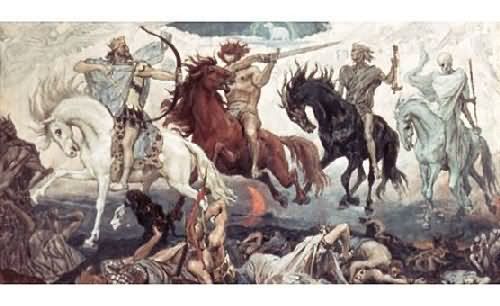
And I saw when the Lamb opened one of the seals, and I heard, as it were the noise of thunder, one of the four beasts saying, Come and see. And I saw, and behold a white horse: and he that sat on him had a bow; and a crown was given unto him: and he went forth conquering, and to conquer. And when he had opened the second seal, I heard the second beast say, Come and see. And there went out another horse that was red: and power was given to him that sat thereon to take peace from the earth, and that they should kill one another: and there was given unto him a great sword. And when he had opened the third seal, I heard the third beast say, Come and see. And I beheld, and lo a black horse; and he that sat on him had a pair of balances in his hand. And I heard a voice in the midst of the four beasts say, A measure of wheat for a penny, and three measures of barley for a penny; and see thou hurt not the oil and the wine. And when he had opened the fourth seal, I heard the voice of the fourth beast say, Come and see. And I looked, and behold a pale horse: and his name that sat on him was Death, and Hell followed with him. And power was given unto them over the fourth part of the earth, to kill with sword, and with hunger, and with death, and with the beasts of the earth.


I couldn't live another day without finding out what the Four Horsemen of the Apocalypse were supposed to represent. Sunday School class was no help at all. The white horse was confusing me. I didn't want to believe he was representative of a punishment, or an AntiChrist, or even unrighteous dominion. It seemed to me that white was symbolic of goodness and purity. But then, how did this horseman fit with the others? My own wisdom was not sufficient. I used Google, and read many interpretations which I could not quite accept. I tried prayer, and was impatiently waiting for a dream, a vision, or a voice in my head, when I remembered a quote from Joseph Smith about understanding the symbols in the scriptures. I looked it up, and here it is in it's entirety:
"I make this broad declaration, that whenever God gives a vision of an image, or beast, or figure of any kind, He always holds Himself responsible to give a revelation or interpretation of the meaning thereof, otherwise we are not responsible or accountable for our belief in it. Don't be afraid of being damned for not knowing the meaning of a vision or figure, if God has not given a revelation or interpretation of the subject." (Teachings of the Prophet Joseph Smith, p. 291.)

I decided to look for a scriptural interpretation of the meaning. Perhaps God had given the meaning to this symbolic passage. My first stop was D&C 77, which is a series of answers to questions about Revelation. It didn't seem to help much, but it did clarify that "the first seal contains the things of the first thousand years, and the second also of the second thousand years, and so on until the seventh." I saw that the four horsemen were associated with the opening of the first four seals.

My next big break happened as I read a little further in Revelation and noticed this description:

Rev 14:14--And I looked, and behold a white cloud, and upon the cloud one sat like unto the Son of man, having on his head a golden crown, and in his hand a sharp sickle.
Then Revelation 19:11-12--And I saw heaven opened, and behold a white horse; and he that sat upon him was called Faithful and True, and in righteousness he doth judge and make war. His eyes were as a flame of fire, and on his head were many crowns; and he had a name written, that no man knew, but he himself.

There it was! The same scriptural symbols--a white horse, a crown, a conquerer--were used to represent Christ. I was vindicated. But I still didn't know why Christ was included in this particular set of four. He didn't seem to fit with the others.

More searching in the scriptures brought me to the obscure book of Zechariah. Did you know that the same four colored horses are mentioned in chapters 1 and 6? News to me. Zechariah even had the presence of mind to ask what these horses meant; and the angel answered that they were "they whom the Lord hath sent to walk to and fro through the earth." Prophets! I realized. Then it became clear to me that the horses were symbols of prophets who were sent to preside over the unveiling of Christ at the opening of each of the seals, or in the thousand year dispensations.

That would make Christ the horseman on each of the horses. I took yet another look to see if I could recognize Christ in these riders. The first was simple: a rider with a bow and a crown who went forth to conquer. The second horseman was sitting on a red horse. The red could represent the blood of Christ. This horseman had power to take peace from the earth. Sounded like Christ's words in Matthew 10:34. The rider of the red horse also had a sword. As I turned back to the rider in Revelation 19 I read: "And he was clothed with a vesture dipped in blood: and his name is called The Word of God. And out of his mouth goeth a sharp sword, that with it he should smite the nations: and he shall rule them with a rod of iron: and he treadeth the winepress of the fierceness and wrath of Almighty God. And he hath on his vesture and on his thigh a name written, KING OF KINGS, AND LORD OF LORDS." This perfectly described the second rider, and identified him with Christ.

The next rider had been identified by many scriptural scholars as "Famine," and this interpretation seemed to fit so well that at first it was hard to see how it might represent the Savior. However, the scales he had in his hands could also represent judgment, and the famine could be a spiritual famine; a hunger for the "Word of God," or Christ. Reading again in Revelation 19 revealed that the horseman "in righteousness he doth judge..."

The final rider had a name: Death. And Hell followed with him. So how did this horseman represent Christ? As I read about how power was given to them to kill with sword, hunger, death, and beasts, I recognized a connection with the rider of Revelation 19 who made war with the kings of the earth, slaying them with the sword and filling the mouths of the fowls with their flesh. This Messiah image, though not as comfortable to us as the loving Good Shepherd, is nonetheless an important scriptural aspect of his reign.

And so this week I have become acquainted with the four horsemen of the Apocalypse--all representative of Christ. This Messiah is revealed to the peoples of the earth by prophets, or the four different colored horses. And if you have made it through this post, you are ready for next week's Sunday School lesson, since my ward is a little bit ahead. I'd love to hear how your Sunday School teacher spins this chapter! Send me a comment.

Labels: , ,

Friday, December 07, 2007

NaBoMoReMo Update


An update on the first week of my NaBoMoReMo: It's been 7 days and I have already read to Jacob 5. I haven't read the Book of Mormon so quickly in quite some time! I usually prefer to take a chapter or even a verse very slowly, looking up relevant scriptures and studying thematically. So it's interesting to be able to see the events in quick succession. I'll just note for you a few things that I saw from reading the Book of Mormon this way.


1. Two stumbling blocks. We all know that the main stumbling block for the Jews was not being able to accept Jesus as the Messiah. 2 Nephi 18:14 (quoting Isaiah 8) says that Christ will be a sanctuary for those who accept him, but for the house of Israel he is "a stone of stumbling" and a "rock of offense." Normally I wouldn't have read 2 Nephi 26 so soon after reading chapter 18. But since I did I noticed Nephi's explanation that the Gentiles must also be convinced that Jesus is the Christ. (v. 12) Their stumbling block is a bit different than that of the Jews. In 26:20 Nephi describes the greatness of the Gentiles' stumbling block: they are lifted up in pride. They have built up many churches but deny the power of God, preaching their own wisdom and making money in the bargain. I sure recognize Jewish and Gentile tendencies in these two descriptions!

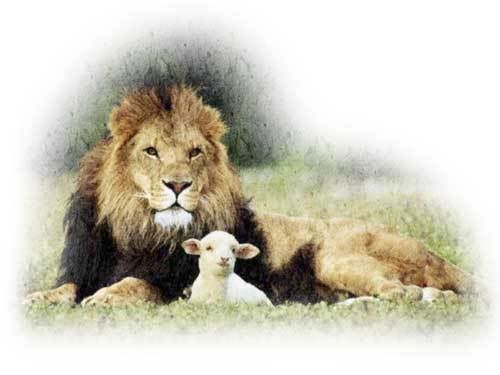
2. The second thing I noticed was a repetition by Nephi of the same Isaiah passage. In 2 Nephi 21:4-9 Nephi quotes the famous passage from Isaiah 11 where the lamb shall lie down with the lion. (Except it actually says the wolf shall dwell with the lamb--the lion eats straw like an ox. We must get that lamb and lion image from Hymn #2!) Later in 2 Nephi 30:9-15 Nephi repeats that very same passage. They shall not hurt nor destroy in all my holy mountain. That's important to me, and I'm glad that Nephi had such strong feelings for the establishment of peace among both man and beast in the last days that he repeated this message twice.


There were many other interesting passages in my Book of Mormon reading, such as the reasons for the Nephites following the Law of Moses when they had already accepted Christ, but these are just two that I hadn't noticed before and that jumped out at me as a result of reading quickly straight through.

If you are reading the Book of Mormon this month, tell us if you've noticed anything new!

Labels: , , ,

Sunday, November 18, 2007

More on the Greater Spirituality of Women

Thanks to DH, I've discovered that there is indeed authoritative support for the notion that women are more spiritual than men. From some preliminary searches, it seems that this idea is a relatively recent innovation in the Church.

From the Church's earliest days, its leaders championed the equality of women in spiritual matters. Although the Prophet Joseph and many who followed him noted the propensity of women for "feelings of charity and benevolence," I have found no indication that these early leaders felt that women had a greater natural spiritual endowment than men. John A. Widtsoe clarified that the priesthood was not given on the basis of capability, competency or excellence, but as a gift. He said,
"Women of a congregation … may be wiser, far greater in mental powers, even greater in actual power of leadership than the men who preside over them. That signifies nothing. The Priesthood is not bestowed on the basis of mental power but is given to good men and they exercise it by right of divine gift, called upon by the leaders of the Church. Woman has her gift of equal magnitude.” (John A. Widtsoe, Priesthood and Church Government, Salt Lake City: Deseret Book Co., 1954, p. 90).

This equality between the sexes in spirituality was preached until the end of the 1970's. Elder Bruce R. McConkie declared in Nauvoo at the dedication of the Monument to Women:
“Where spiritual things are concerned, as pertaining to all of the gifts of the Spirit, with reference to the receipt of revelation, the gaining of testimonies, and the seeing of visions, in all matters that pertain to godliness and holiness and which are brought to pass as a result of personal righteousness in all these things men and women stand in a position of absolute equality before the Lord. He is no respecter of persons nor of sexes, and he blesses those men and those women who seek him and serve him and keep his commandments.” (Bruce R. McConkie, Ensign, Jan. 1979, p. 61.)

One of the first comments about a special spiritual sensitivity on the part of women that I have been able to find came from Neal A. Maxwell. In explaining women's roles in the Church and in they eyes of God he cited some of the notable women of the Bible:
"When we would measure loving loyalty in a human relationship, do we not speak of Ruth and Naomi even more than David and Jonathan?... A widow with her mite taught us how to tithe. An impoverished and starving widow with her hungry son taught us how to share, as she gave her meal and oil to Elijah. The divine maternal instincts of an Egyptian woman retrieved Moses from the bullrushes, thereby shaping history and demonstrating how a baby is a blessing—not a burden... Does it not tell us much about the intrinsic intelligence of women to read of the crucifixion scene at Calvary, "And many women were there beholding afar off." (Matt. 27:55.) Their presence was a prayer; their lingering was like a litany. And who came first to the empty tomb of the risen Christ? Two women. Who was the first mortal to see the resurrected Savior? Mary of Magdala. Special spiritual sensitivity keeps the women of God hoping long after many others have ceased" (Neal A. Maxwell, "The Women of God," Ensign, May 1978, 10).

Also about this time, Spencer W. Kimball also began to extol the virtues of womanhood. He made the following comment, which can be construed to mean that women have more of a natural inclination toward spirituality than men, and thus are more likely to join the Church:
"...much of the major growth that is coming to the Church in the last days will come because many of the good women of the world (in whom there is often such an inner sense of spirituality) will be drawn to the Church in large numbers. This will happen to the degree that the women of the Church reflect righteousness and articulateness in their lives and to the degree that women of the Church are seen as distinct and different—in happy ways—from the women of the world." (Spencer W. Kimball, Ensign, Nov. 1979, pp. 103–104).

Perhaps the greatest champion of women's greater spiritual capacity was James E. Faust. He gave many talks for and about women beginning in the 1980's. Some of these included
Womanhood: The Highest Place of Honor,
What it Means to be a Daughter of God, and
You Are All Heaven-Sent.

President Faust repeatedly told women that they had an inner spiritual strength that surpassed that of men. See DH's blog post for several quotes by President Faust along these lines.


President Faust's ideas were reiterated by several of the other Apostles. Boyd K. Packer said that men and women are by nature different, and while they share many basic human traits, the “virtues and attributes upon which perfection and exaltation depend come [more] naturally to a woman.” (Boyd K. Packer, For Time and All Eternity,” Ensign, Nov. 1993, 22).


M. Russell Ballard told women,
"Now, finally, I turn again to you dear sisters, you who have such a profound, innate spiritual ability to hear the voice of the Good Shepherd. You need never wonder again if you have worth in the sight of the Lord and to the Brethren in the presiding councils of the Church. We love you. We cherish you. We respect you. Never doubt that your influence is absolutely vital to preserving the family and to assisting with the growth and spiritual vitality of the Church. This Church will not reach its foreordained destiny without you. We men simply cannot nurture as you nurture. Most of us don’t have the sensitivity—spiritual and otherwise—that by your eternal nature you inherently have. Your influence on families and with children, with youth, and with men is singular. You are natural-born nurturers. Because of these unusual gifts and talents, you are vital to taking the gospel to all the world, to demonstrating that there is joy in living the way the prophets have counseled us to live." (M. Russell Ballard, “Women of Righteousness,” Ensign, Apr 2002, 73).


These teachings by the General Authorities have been repeated by local leaders and members and sometimes used to promote the idea that the priesthood is given to men to compensate for his lesser spiritual ability. It is also said that the priesthood can help men develop spirituality, a gift that women do not need since their spirituality is innate. This idea has been repeated despite the lack of prophetic approbation. Apparently this year (2007) marks the first time a General Authority has espoused linking the Priesthood and a woman's spirituality. An article by Bruce C. Hafen, a member of the Quorum of the Seventy in a recent Ensign reads:
"Spouses need not perform the same functions to be equal. The woman’s innate spiritual instincts are like a moral magnet, pointing toward spiritual north—except when that magnet’s particles are scrambled out of order. The man’s presiding gift is the priesthood—except when he is not living the principles of righteousness. If the husband and the wife are wise, their counseling will be reciprocal: he will listen to the promptings of her inner spiritual compass just as she will listen to his righteous counsel." (Bruce C. Hafen and Marie K. Hafen, “Crossing Thresholds and Becoming Equal Partners,” Ensign, Aug 2007, 24–29).


Due to my study of the words of the recent General Authorities, I am now more prepared to accept that perhaps women are endowed with an innate spiritual gift. It is certainly a beautiful thought as worded by Maxwell and Hafen. However, I wonder at the wisdom of proclaiming that the bestowal of the Priesthood upon the male sex is compensatory. I object to the idea that Priesthood is given to the less spiritually inclined to help them "catch up." Look at the way Priesthood works among men: it is not given to the less spiritual among males to help them become stronger. Rather, men who have already proved worthy are ordained to Priesthood offices so that they may lead, serve, bless, and speak in the name of God.

I would like to explore these ideas further. I am especially interested to know if there are any statements about women's greater spirituality coming from authoritative sources before 1978. Was this idea expounded at all before the time of the Women's Movement in the '70's? If not, what was the reason for the doctrinal shift?

Labels: , ,

Friday, November 16, 2007

SS Permutations on the Letters of John

OOOOOOHHHH, just wait until you hear what was discussed in SS today under the auspices of 1st, 2nd, and 3rd John! Bro. SS Teacher went from expounding on the topic that "God is Love" to telling us that women are naturally more spiritual than men, one of those Mormon throwaway statements that annoys me greatly. I was sitting in the second row, which you Mormons know really means the first row, and I said, just loud enough for him to hear, "Could you repeat what you just said???" in an incredulous tone. So he further expounded, "Yes, women are more spiritual than men, that is why men have the priesthood." And I couldn't let that pass, so I replied, this time loud enough for everyone in the room to hear, "You have absolutely no scriptural support for that opinion." And, dear readers, he TOOK ME ON with chin raised high as he spouted more extreme speculation: "Of course they are more spiritual than men, otherwise why would we have polygamy if not for the condition that will exist in heaven of more righteous women than men?"

And the whole room erupted in buzzing private conversations.

Bro. SS Teacher went on for quite a while in this vein, saying that he had come to this conclusion after "working backward from the scriptures." Meanwhile, I was accosted from behind by a woman who was visiting in the ward. She was anxious to tell me her story about when she was single and had many struggles with immorality. She went to her Bishop to discuss the unfairness of having to remain chaste for eternity and her equal horror of solving the problem by becoming the plural wife of some hypothetical man. The Bishop calmed her fears by telling her of the many male babies who died in infancy, thus evening the male/female ratio in heaven. (Heard that before, folks?) Not understanding my objection to the SS Teacher's comments, she mistakenly felt she had put to rest my anxieties.

I am reminded of the reason why I rarely challenge ignorant statements made in Church meetings. I find that 90% of the time, the members of the class are unable to understand what my objection is. But, lucky me--now I have my blog to spout off on.

Those of you who know me well have discovered that polygamy is not one of the doctrines which troubles me. Rather, my issues lie with this "Mormonism" that priesthood is given to men to compensate for their alleged lack of spirituality compared to women. In the next few days, I'll be looking for the answers to these questions. Help me out, readers, if you will:

1. Is there any doctrinal support for this notion, i.e. Conference Talks, or authoritative statements from Mormon leaders? (I'm already pretty sure you can't come to this from scripture, working backward or forward or any other way. But if there are scriptures that can be construed to make this assertion, what are they?)

2. Would a "greater spirituality of women" postulation support bestowal of the priesthood upon men to the exclusion of the entire female population?

3. What arguments have been made against the idea from an LDS point of view (GA statements, Sunstone/Dialogue articles, blog posts)?

4. Is there a succinct reply contesting this type of assertion that one could make in the context of polite company, say a SS/PH/RS lesson?

Labels: , , , ,