Sunday, March 23, 2008

Hallelujah! Christ Arose!

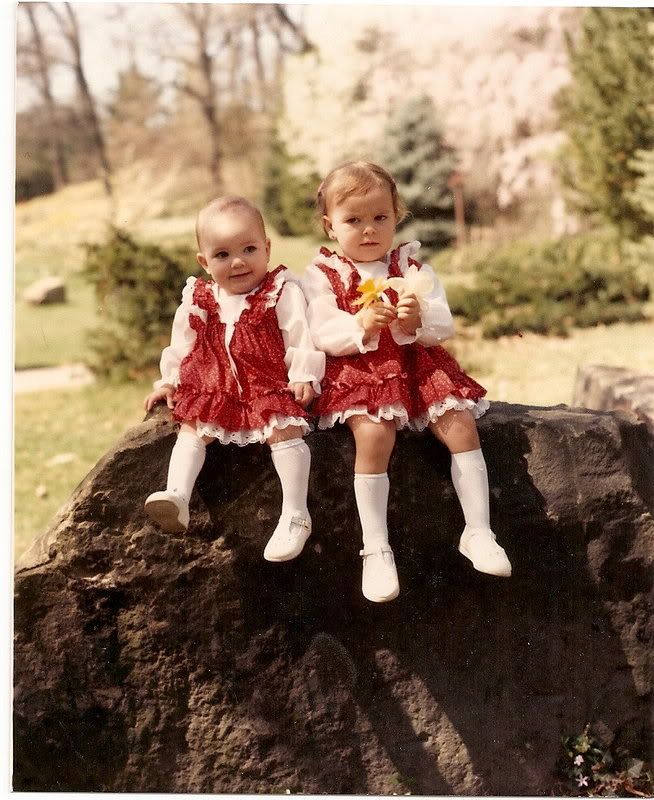
The Easters of my childhood could not be more different than those of my children. As a "Preacher's Kid," those Sundays in early spring of the '60's and '70's recall new patent leather shoes, pastel dresses, hats, and little white gloves. Easter lilies adorned the house, with the largest one placed on my grandmother's handmade doily on the grand piano in the front room. My father had written a special sermon which we would all discuss at the table that evening when we ate our traditional ham dinner. I sat sedately on the pew with my knees together, and head bowed. It was a special, awe-filled, reverent day, and I felt great joy well up in my heart as we sang the Protestant Easter hymns. "Christ the Lord is Ris'n Today" was twice as fast and toe-tapping as any Mormon ward has ever performed it, and then, my personal favorite:
Low in the grave He lay, Jesus my Savior,
Waiting the coming day, Jesus my Lord!

Refrain

Vainly they watch His bed, Jesus my Savior;
Vainly they seal the dead, Jesus my Lord!

Refrain

Death cannot keep its Prey, Jesus my Savior;
He tore the bars away, Jesus my Lord!

Refrain:
Up from the grave He arose,
With a mighty triumph o’er His foes,
He arose a Victor from the dark domain,
And He lives forever, with His saints to reign.
He arose! He arose!
Hallelujah! Christ arose!

Fast forward to the 1980's and '90's. BiV tries valiantly to recall the Easters of her youth as she sews 7 matching Easter dresses every year, and volunteers to write Easter cantatas for Sacrament meetings. But most years Easter falls on General Conference days, and we lie around the house in PJ's, munching on chocolate bunnies and putting jellybeans on Conference Bingo cards while watching the talking heads. Frustration mounted through these years. I wondered how we could come from such a wonderful musical tradition with the Mormon Tabernacle Choir, and be satisfied with Ward Choirs who thought an acceptable Easter production was singing "He is Risen" with the men singing the first verse, the women singing the second, and all joining together on the third. Talks and lessons went on in the usual schedule, sometimes with nary a mention of the resurrection. Mormons don't do JOY on Easter, I realized.

That's when I started worshipping with my local Baptist congregation on Easter. No, I didn't miss Church (or any of the Conference sessions). But I'd search for a sunrise service, or one that didn't conflict with any of our meeting times, and I'd slip over for an hour every Easter. DH was against it, so I didn't bring any of the children. It was just me, feeling the great spirit of Resurrection morning in an anonymous way with a group of people I didn't know.

One Easter I found myself in a rather large Christian church with lovely stained-glass and a 200-voice choir. The program was a live musical rendition of the Easter story. I was sitting in an aisle seat midway back when suddenly the doors behind me swung wide open and a bearded actor in a homespun robe entered the building, sitting on a real donkey! He passed, close enough to touch, and I felt an amazing emotional reaction. At that moment, I realized in a visceral way that Jesus was a historical, real, vital person who had actually lived and walked around on this earth. People had seen him, and touched him, and listened to his message. I felt a conviction that he had risen from the dead, as the scriptures relate. I thought it not impossible that he had physically appeared to a farm boy in New York in answer to a sincere prayer. It was the strongest testimony of the reality of the Savior and of the restoration of the gospel that I had yet experienced.

Perhaps it might seem odd that I could receive such a strong witness of the Restored Gospel in such a place. Or maybe it is perplexing that here on my questioning, often critical blog I would include my assurance of a personal Savior. But to all my readers, seeking or not, believing or not, I offer you my Easter story, however you will receive it. It is why I struggle to find answers to the conundrums of Mormonism. It is why I stay when others tell me to go find another church. It is why I roll my eyes at some of the policies and practices and then I go and do what I am told. It is why I put up with the abuses of patriarchy and the sore spots where other struggling sinners scrape against my weaknesses.

There's a place within me that loves Jesus. I join with you to shout Him welcome this Easter morning.

*

Labels: , ,

Saturday, February 09, 2008

Temple Initiatories from a Faithful Feminist Perspective

Today I am home alone (Yippee!) and instead of scrubbing the bathtub my mind is wandering in all kinds of strange directions.

I've been thinking about the temple initiatory for women and wishing I could discuss it from a faithful, feminist perspective. Unfortunately, there are some obstacles which stand in my way of doing this. Number one, of course, is the proscription from discussing certain sacred aspects of the temple. I'm a bit more liberal than many in talking of my temple experiences. I think there are certain parts in the temple which we are clearly told not to discuss, and I'm willing to draw the line there. But can we talk about the initiatory? Most Mormons won't talk about anything remotely associated with the temple. Even among other endowed members. So bringing up any of my wonderings on this subject with fellow Latter-day Saints will be met with resistance.

Next obstacle is my physical distance from the nearest Temple. The last time I attended was the day before we moved to the Middle East, and my next opportunity to go will probably be in June, when we go back to the States for Summer vacation. But even had I the chance to go to the temple, would I find someone with whom I could discuss my concerns while sitting around the Celestial Room?

The quiet, meditative setting of the Celestial Room is not always conducive to a robust investigation of the sort I am contemplating. I yearn to talk about the 2005 changes to the initiatory ordinance. I loved doing initiatories before the changes, and I found a lot of spirituality, intimacy, and symbolism have been removed. I'd like to talk about these things with a faithful LDS woman who misses this as well, but isn't about to lose her recommend over it. I'd like to find someone who isn't freaked out by the presence of large tubs of water in early SLC Temple ordinance rooms and the liberal pouring of consecrated oil from large horns over the crown of the head. But I'd want her to be feminist and knowledgeable enough to also discuss the differences between the male and female versions of the pre-2005 ordinance and their implications for feminists. We'd talk about the words "having authority," "under proper authority," and "now authorized." We'd discuss esoteric, mystical, symbolist, and romantic approaches to the initiatory. We'd speak of the importance of ritual and what, if any, priesthood is exercised by women ordinance workers.

Do you think I can hold out any hope for such a discussion? Must I always hold the sacred/secret deep within a cavern in my heart, never to see the light of day? Or do you think that Dan Wotherspoon might be able to arrange a Wednesday night Sunstone temple session, complete with discussion period in the upper Assembly room, as a special part of this year's Symposium?

I can always dream...or perhaps I should go scrub that bathroom now.

Labels: , , , ,

Sunday, November 18, 2007

More on the Greater Spirituality of Women

Thanks to DH, I've discovered that there is indeed authoritative support for the notion that women are more spiritual than men. From some preliminary searches, it seems that this idea is a relatively recent innovation in the Church.

From the Church's earliest days, its leaders championed the equality of women in spiritual matters. Although the Prophet Joseph and many who followed him noted the propensity of women for "feelings of charity and benevolence," I have found no indication that these early leaders felt that women had a greater natural spiritual endowment than men. John A. Widtsoe clarified that the priesthood was not given on the basis of capability, competency or excellence, but as a gift. He said,
"Women of a congregation … may be wiser, far greater in mental powers, even greater in actual power of leadership than the men who preside over them. That signifies nothing. The Priesthood is not bestowed on the basis of mental power but is given to good men and they exercise it by right of divine gift, called upon by the leaders of the Church. Woman has her gift of equal magnitude.” (John A. Widtsoe, Priesthood and Church Government, Salt Lake City: Deseret Book Co., 1954, p. 90).

This equality between the sexes in spirituality was preached until the end of the 1970's. Elder Bruce R. McConkie declared in Nauvoo at the dedication of the Monument to Women:
“Where spiritual things are concerned, as pertaining to all of the gifts of the Spirit, with reference to the receipt of revelation, the gaining of testimonies, and the seeing of visions, in all matters that pertain to godliness and holiness and which are brought to pass as a result of personal righteousness in all these things men and women stand in a position of absolute equality before the Lord. He is no respecter of persons nor of sexes, and he blesses those men and those women who seek him and serve him and keep his commandments.” (Bruce R. McConkie, Ensign, Jan. 1979, p. 61.)

One of the first comments about a special spiritual sensitivity on the part of women that I have been able to find came from Neal A. Maxwell. In explaining women's roles in the Church and in they eyes of God he cited some of the notable women of the Bible:
"When we would measure loving loyalty in a human relationship, do we not speak of Ruth and Naomi even more than David and Jonathan?... A widow with her mite taught us how to tithe. An impoverished and starving widow with her hungry son taught us how to share, as she gave her meal and oil to Elijah. The divine maternal instincts of an Egyptian woman retrieved Moses from the bullrushes, thereby shaping history and demonstrating how a baby is a blessing—not a burden... Does it not tell us much about the intrinsic intelligence of women to read of the crucifixion scene at Calvary, "And many women were there beholding afar off." (Matt. 27:55.) Their presence was a prayer; their lingering was like a litany. And who came first to the empty tomb of the risen Christ? Two women. Who was the first mortal to see the resurrected Savior? Mary of Magdala. Special spiritual sensitivity keeps the women of God hoping long after many others have ceased" (Neal A. Maxwell, "The Women of God," Ensign, May 1978, 10).

Also about this time, Spencer W. Kimball also began to extol the virtues of womanhood. He made the following comment, which can be construed to mean that women have more of a natural inclination toward spirituality than men, and thus are more likely to join the Church:
"...much of the major growth that is coming to the Church in the last days will come because many of the good women of the world (in whom there is often such an inner sense of spirituality) will be drawn to the Church in large numbers. This will happen to the degree that the women of the Church reflect righteousness and articulateness in their lives and to the degree that women of the Church are seen as distinct and different—in happy ways—from the women of the world." (Spencer W. Kimball, Ensign, Nov. 1979, pp. 103–104).

Perhaps the greatest champion of women's greater spiritual capacity was James E. Faust. He gave many talks for and about women beginning in the 1980's. Some of these included
Womanhood: The Highest Place of Honor,
What it Means to be a Daughter of God, and
You Are All Heaven-Sent.

President Faust repeatedly told women that they had an inner spiritual strength that surpassed that of men. See DH's blog post for several quotes by President Faust along these lines.


President Faust's ideas were reiterated by several of the other Apostles. Boyd K. Packer said that men and women are by nature different, and while they share many basic human traits, the “virtues and attributes upon which perfection and exaltation depend come [more] naturally to a woman.” (Boyd K. Packer, For Time and All Eternity,” Ensign, Nov. 1993, 22).


M. Russell Ballard told women,
"Now, finally, I turn again to you dear sisters, you who have such a profound, innate spiritual ability to hear the voice of the Good Shepherd. You need never wonder again if you have worth in the sight of the Lord and to the Brethren in the presiding councils of the Church. We love you. We cherish you. We respect you. Never doubt that your influence is absolutely vital to preserving the family and to assisting with the growth and spiritual vitality of the Church. This Church will not reach its foreordained destiny without you. We men simply cannot nurture as you nurture. Most of us don’t have the sensitivity—spiritual and otherwise—that by your eternal nature you inherently have. Your influence on families and with children, with youth, and with men is singular. You are natural-born nurturers. Because of these unusual gifts and talents, you are vital to taking the gospel to all the world, to demonstrating that there is joy in living the way the prophets have counseled us to live." (M. Russell Ballard, “Women of Righteousness,” Ensign, Apr 2002, 73).


These teachings by the General Authorities have been repeated by local leaders and members and sometimes used to promote the idea that the priesthood is given to men to compensate for his lesser spiritual ability. It is also said that the priesthood can help men develop spirituality, a gift that women do not need since their spirituality is innate. This idea has been repeated despite the lack of prophetic approbation. Apparently this year (2007) marks the first time a General Authority has espoused linking the Priesthood and a woman's spirituality. An article by Bruce C. Hafen, a member of the Quorum of the Seventy in a recent Ensign reads:
"Spouses need not perform the same functions to be equal. The woman’s innate spiritual instincts are like a moral magnet, pointing toward spiritual north—except when that magnet’s particles are scrambled out of order. The man’s presiding gift is the priesthood—except when he is not living the principles of righteousness. If the husband and the wife are wise, their counseling will be reciprocal: he will listen to the promptings of her inner spiritual compass just as she will listen to his righteous counsel." (Bruce C. Hafen and Marie K. Hafen, “Crossing Thresholds and Becoming Equal Partners,” Ensign, Aug 2007, 24–29).


Due to my study of the words of the recent General Authorities, I am now more prepared to accept that perhaps women are endowed with an innate spiritual gift. It is certainly a beautiful thought as worded by Maxwell and Hafen. However, I wonder at the wisdom of proclaiming that the bestowal of the Priesthood upon the male sex is compensatory. I object to the idea that Priesthood is given to the less spiritually inclined to help them "catch up." Look at the way Priesthood works among men: it is not given to the less spiritual among males to help them become stronger. Rather, men who have already proved worthy are ordained to Priesthood offices so that they may lead, serve, bless, and speak in the name of God.

I would like to explore these ideas further. I am especially interested to know if there are any statements about women's greater spirituality coming from authoritative sources before 1978. Was this idea expounded at all before the time of the Women's Movement in the '70's? If not, what was the reason for the doctrinal shift?

Labels: , ,

Sunday, November 11, 2007

Sabbath-day Thorn in my Side

Stake Conference in our Stake is a bit different than in other places in the world. Because the units are spread out over a vast area, the stake leaders bring the conference to each ward. Members are warned several weeks before the Conference that it will be their chance to obtain a temple recommend. Interviews with the Bishop are held, and the Stake President is available after the meetings to conduct interviews. It is perhaps the only time members will see Stake leaders for 6 months or a year. Because of the difficulties in traveling and in women getting around, the wives of the Stake Presidency are called to be the Stake RS President, Stake YW President, and Stake Primary President.

I enjoyed meeting our Stake leaders, and I had a chance to talk personally with each of the women leaders. They were very nice, and I enjoyed our conversations. They are about my age, and I think I could be good friends with each one of them. However, I cannot contain my opinion of their talks. As I've said before, women leaders have a great opportunity when they speak in Conferences. It is their opportunity to have a voice in the administration of the Church. It is one of a very few times that they can appropriately give counsel and instruction to the general membership of the Church, including men, women, and children. Not surprisingly, I was looking forward to hearing what these women would say during our General Session and also during our Adult Session.


So what did I hear from our illustrious women leaders? None other than RECYCLED CONFERENCE TALKS!! It's the biggest Sabbath-day thorn in my side there is. I don't like when anyone gives recycled Conference Talks. I'm fine with themes are given to speakers, but I feel they should be developed by the speakers themselves, with personal experiences and relevant scripture stories chosen according to personal guidance of the Spirit. This way both speaker and listeners are enriched. A Conference Talk summarized again and again in Sacrament and other meetings loses its immediacy and power that it had when the message was received and given by the General Authorities. I and many other members of the Church read our Conference Ensigns and are quite familiar with the talks. Hearing them summarized in Church is boring.

None of the men speakers at our Stake Conference gave recycled Conference Talks. Every woman who spoke summarized a Conference Talk. None of the women even went so far as to include a personal experience or opinion on the topic. I'm extremely disappointed. By doing this, we women are diluting what little authority and influence we do have. For shame.

Labels: , , ,

Saturday, August 11, 2007

Snarker, be Damned: Another Sunstone Testimony

I finally have internet access again (!)and Snarker be damned, I am going to post my little heart out about how wonderful and spiritual it was. I believe that the types of talks and panels at Sunstone have the power to touch the questioning and questing among us in a way that speaks to our souls.

On Thursday, the Mormon Women's Forum presented a panel titled "Image and Reality: The Many Faces of Mormon Women. Janice Allred led the panel and explained that the concept of face invites us to consider several contrasting pairs that define face: appearance vs. reality, public vs. private, open vs. hidden, engaged vs. withdrawn, present vs. past, and ideal vs. real. Each of the panelists addressed how Mormon women negotiate the tension between the ideal and the reality of their own lives. Since I was one of the panelists, I'll post my remarks here for your edification!
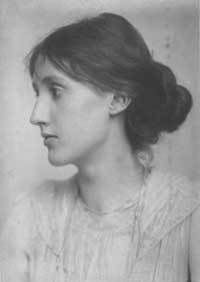
Virginia Woolf wrote: "a woman must have money and a room of her own if she is to write fiction." I identify with this statement because I realize that in order to accomplish great things, one must have the means and the space. I sometimes wonder if, within Mormonism, a woman can find "a room of her own." From the time a Latter-day Saint girl or boy is very young, words of testimony are whispered in their ears. They memorize all 12 Articles of Faith and are taught songs of faith and assurance. The Young Women stand each week and recite a motto describing the ideal girl. An active teenage girl who attends Church services, Mutual, and Seminary goes to Church 10 or more hours a week. She is interviewed by her Bishop twice a year to assess her worthiness. Often, this young woman will marry at a fairly young age and begin Church and family responsibilities before she has ever really lived on her own.

These can all be wonderful influences. They tend to produce women who have lived clean, decent lives; who have not mired themselves in addictions. These women are trained and prepared to keep clean and organized homes and to raise upstanding families. Are they missing anything from never having had a room of their own?

I think our strength as a culture is that we tend to develop the public face of our people superbly. As a young wife, I had learned how to present that face to the ward and to the world. I was well-spoken, well-groomed, energetic. I had the skills to run a Parent-Teacher Organization or to speak in public. This picture shows 6 of my eventually 8 children. As you can see, I sewed matching dresses for these girls. I did it three times a year: Christmas, Easter, and Pioneer Day.

But the public appearance was very different from the private reality.

At times I found friends I could share the tough realities of my life with. But in my experience, the Mormon world was not conducive to such confidences. As a Latter-day Saint, I felt compelled to put on a good face for the world. To my non-member friends and neighbors, I felt that I needed to show them how happy being a member of the Church made me. I couldn’t reveal any marital problems, for that would put a bad light on our “eternal family” rhetoric. I didn’t feel free to complain about the pressures of having 8 children, because it might invalidate my reasons for having such a huge family. Among the other LDS women, I felt some competition and equal pressure to maintain the image of perfection. Especially when I was a young mother, I didn’t realize that other Mormon women might also be struggling.

Putting forth a good face is also an inherited trait in my family. To illustrate this, I’d like to share a story my mother wrote in her family history. She tells of going to see a Broadway musical review with her sisters. Since they knew someone in the production, they were invited to go backstage. They left their seats during the final number and were ushered back behind the curtains to watch the chorus line finale. They saw the dancers with big, bright smiles upon their faces while they faced the audience. But when they turned their backs on the crowd, the girls’ faces would relax into a frown or a scowl of concentration. By the time they turned back around, they had their smiles pasted back on. My mother compared this chorus line to her family. She said that in public, they always had to have their smiles on.

I wrote a poem (some of my blog readers will remember this!) which expresses the liminality I have felt as I have attempted to please my family, my Church, and especially my husband without being able to fully celebrate the nontraditional parts of myself. It’s called, “I Put on Black.”

I put on black,
My head I bow.
You like me now.
You like me now.

I put away my chartreuse scarf,
And colored things I used to wear.
My second piercings now are bare,
I gel down my unruly hair.

I do not have a lot to say.
My makeup now is quite subdued.
I seem to cook a lot of food,
I don’t go swimming in the nude.

I nod and murmur when I should,
I shut my mouth, my thoughts I still,
My questions and my quirks I kill--
My secret longings none can fill.

The ward is suddenly so kind.
I’m not as different now, you see!
A call has been extended me
To teach Relief Society.

Sedately I walk down the aisle,
The Bishop’s wife sits by my side,
She nods at me; you smile with pride,
I feel a tearing deep inside.

I clean the toilets and the hall,
Read stories to my sweet sunbeams.
We never argue now, it seems.
I wonder where I put my dreams.

Your temple marriage now is safe,
You hold my hand that wears the ring.
I never dance, I never sing,
You would not notice such a thing.

I’m all in black,
I’ve kept my vow,
You like me now,
You like me now.

But this is what
You do not see:
I don’t like me,
I don’t like me.

When my family moved to the small, provincial town of Vernal, Utah two years ago, I discovered blogging. I felt I had found “A room of my own,” where I could present my innermost thoughts and feelings, ideas I’ve long held, but didn’t always align with the perfect Mormon woman. On my blog, I call myself “Bored in Vernal,” a feminist, pacifist, disgruntled, yet fully active Latter-day Saint. I’ve found the cyberworld to be a place where I can explore the real me among those with a Mormon background. I’ve found that I can’t leave the Church behind. It is a deep and inextricable part of me. Yet there are some policies, procedures and doctrines that, in order to be authentic, I must take exception to. Even at the ripe old age of 47, I’m still trying to find myself. Right now, it’s almost like I live a double life. I find myself saying things at Church, then saying the polar opposite on my blog. Which do I really believe? At the time I say these things, I feel I am representing myself accurately. I’m so confused. What are my true feelings? Who am I?

One of the objectives of this panel was to explore how Mormon women negotiate the tension between the roles and expectations of Mormon culture and the reality of their own lives. I pondered this as I read a recent novel entitled “Snow Flower and the Secret Fan.” The book is about nineteenth-century China and a group of women in Jiangyong, a far flung area in the rural countryside. These traditional Chinese females experienced the binding of the feet at age 7, early marriage, and a secluded life thereafter. While embracing the expectations of their culture, the women of this community developed practices which enabled them to survive. To meet their needs for community, the women contracted with other females—either “sworn sisters” or “old sames.” The novel is based on factual evidence that these women developed a secret system of writing by which they could communicate. It was called “nu shu,” and was kept secret for over a thousand years.

I believe that women such as myself who find tension between traditional Mormon roles and their own personal paradigms must find some way to relieve the strain. What practices will they develop which will enable them to survive and flourish? Will it be online communities such as blogging, or email groups? As wards become more accepting of diversity, will they find kindred spirits within the ward with whom they can commiserate? Or will these women find fulfillment in jobs outside the home, retaining their cultural roles only while at home and at Church?

Through the Proclamation on the Family, the Church has shown its commitment to traditional roles for women. Within our illustrious history, though, there have been some few opportunities for women, even within this type of culture, to find “a room of their own.” I’m thinking of women such as Ellis Shipp, who was sent back East by Brigham Young to obtain a medical degree. She practiced and taught medicine in Utah while bearing ten children. Women like Minerva Teichert, who went to Chicago to take art lessons as a “set apart” missionary of the LDS church. She married, raised a family, cooked and helped with the ranch while painting prolifically throughout her life. I’m thinking of Relief Society sisters who collected grain for humanitarian service, wrote their own manuals, maintained their own budgets and buildings. I urge that we continue to draw upon these, and many other examples of women who embraced their cultural roles within Mormonism yet broadened the definition of womanhood to find a room of their own from which to reach out and touch the world.

Stay tuned! I'll be posting much more of my experiences from Sunstone.

Labels: , , ,

Wednesday, June 20, 2007

Coming to Terms With Polygamy--A Response


In this post I respond to Caroline's questions at Exponent2 blog regarding how I have come to terms with polygamy.

I have several different thoughts. First, I believe that the Church continues to practice polygamy today. Because sealings to multiple wives continue to be practiced in the Temple, and because we believe in an afterlife, polygyny is something we must come to terms with as Latter-day Saints.

In the early days of the Church many leaders declared that polygyny was necessary in order to be exalted. However, Melvin J. Ballard refuted this idea in (I think) 1912 when he said that a man sealed to one wife could be exalted. Thus, my thinking is that polygamy is not necessary. (You just have to convince your husband not to be sealed to another wife after you die!) There are many women who are repulsed by the doctrine (how much of this is cultural conditioning we do not know), and imo they will not be forced to live it. Other families have been sealed into the principle. There is no evidence to suggest that these sealings will be dissolved. My opinion is that they will continue in the next life. Whether or not we personally contract into a polygamous union, it remains so much a part of our doctrine that I doubt any of us will not be personally affected in some way.

I'm not against polygamy myself. But I've had different experiences than many of you. My parents were involved in polygyny from the time I was age 12. It had nothing to do with Mormonism or religion, it was a lifestyle choice. I did not agree with my parents' choice to bring another wife into the family. The choice had many negative repercussions regarding the four children's relationships with our mom and dad. Nonetheless, I saw that it was a viable lifestyle. There was little, if any jealousy. The three adults usually acted as a cohesive unit (much to our dismay as children!) Living closely as a family made it impossible to hide any problems or tensions. I must admit that they were very few and usually solved with patience, tolerance, and love. Both women lived in our home and had separate bedrooms. (I have No Idea what the sexual arrangements were--and I don't want to think about it! Please! They're my parents!) Both women were employed full-time (the youngest child was already school age). Both women had feminist inclinations. Both women as well as my dad shared household responsibilities. All three were very happy with the arrangements, and seemed close and emotionally connected. Thus my personal experience has convinced me that polygyny is a lifestyle that can be lived in love and satisfaction for all parties.

In addition, I have always had very close female relationships. Always. Until I came to Vernal I always had female friends I could rely on emotionally. A woman will listen to you hash the same experience out umpteen million times. A man will (usually) listen to it once. Then he will want you to solve it or get over it. (Yes, I know I'm generalizing a bit!) But there are many reasons that I find a woman to be better "best friend" material than a man.

I can imagine retaining my feminist sensibilities in a polygynist relationship. In fact, I can picture myself in a coterie of chattering females, discussing a book we've read until 3 in the morning, while polygamist hubby waits alone and cold in the upstairs bedroom!

The last point I wish to make is the "obedience" issue. I read two posts at FMH dealing with this issue (See #1 and #2). It interests me that Mormon women who are traditional in every way state that they would rather give up their exaltation than live polygamy. I wonder at statements that if polygamy was reinstated they would "flatly refuse" to obey prophetic counsel. I am often taken to task on this blog for some of the stances I take. Conventional believers would have me adhere more closely to prophetic counsel. Yet it seems acceptable, on the blogs and in wards in which I've lived, to rebel against this one principle.

As I wrote this post, I asked my husband if he would ever want to live polygamy, and he was emphatically negative. He doesn't feel up to dealing with multiple females. I guess most of that is my fault! I think he finds me emotionally taxing. So perhaps I will never have to face this issue head on. I'm not like my parents; I don't believe polygamy is something to be entered into without the specific instructions of the living Prophet of God. But I like to think that if "The Principle" was required of us once again, I would see it as a fascinating and fulfilling adventure.

Labels: , , , , , ,

Friday, June 08, 2007

What Advice Would You Give This Missionary?


This is a leaf taken from my Missionary Journal from Thursday, 27 August 19xx in Beloeil, Quebec, Canada. It was one of my very first District Meetings.

Today we had a District Meeting to set goals for September. It was really hard because I couldn't understand why we were setting goals for baptisms, etc, if it didn't depend on us, it depended on the free agency of the person. We finally figured out that the only way it made any sense is if this was the number of baptisms the Lord would give us if we did all we were supposed to, taking into account the people that would fall through, etc.

Sister R. and I came up with the number of 4 Baptisms for our area. This is really scary because it means at the end of the month if we don't get 4 Baptisms it is because of something we did wrong, or OUR lack of faith. We are really stepping out in faith, something I haven't really tried before. If we don't make our goal, the District will say, "Why didn't it work, Sister L.?" I was so sure of it before, but fear has crept in a little bit.

I want to call down the powers of heaven by doing all the things I'm supposed to do, so that by obedience to the law, the Lord will be bound to give me the blessings. What I just don't know are all the things I must do to gain the blessing of baptizing. What is the law upon which it is predicated? I have tried to make an exhaustive list, and I am determined to follow them. If this works out, it will add a great deal to my faith. And I want so badly to be able to develop my faith!


Here are some of my questions:
Do missionaries still make monthly baptismal goals?
How do you think such goals fit with free agency?
When the goals are not met, is it the fault of the missionary?
How does D&C 130:21 apply to missionary goals?
Do you think attributing not meeting our goals to our own sin is doctrinal? Is it healthy?

Labels: , , , ,

Wednesday, May 16, 2007

Our Family is Complete--The Decision

I was recently asked the question, "When did you decide your family was complete? Did you have any sort of revelation/answer that you are 'done' with having children?"

I remember exactly when I started feeling scared about having so many children. It was right after #5 was born. She was about a week old and I was feeling well enough to go for a walk. I had baby in a sling, #3 and #4 in the double stroller, and #1 and #2, who were only 5 and 6 years old, were on either side of me on their bikes, with training wheels, not really able to ride well yet. We started walking down the sidewalk in a big parade. I thought, "What have I done?!! There is no way I can do this."

For the first time, I had postpartum depression with this baby. It was sort of a "functional" depression--from the outside I looked like I was OK. I held Church callings, homeschooled like crazy, (I taught all of my kids to read by age 3, had them all working 2 grades ahead of their ages), and did projects like stripping all of the wallpaper off a large home and repainting.) But I lost a lot of weight and lived an entire fantasy life inside my head. My husband and I had horrible fights, I hurt myself and had suicidal thoughts constantly. It was an awful year.

How did I deal with it? After about a year, we moved, which sort of put everything into a new perspective, I read a book called "Cognitive Therapy" and started practicing it (more on that later) and I became more realistic about what "being a good mother" entails. Then I had another baby. My husband went back to school to get his PhD. We lived on less than $10,000 a year for 3 years. Here's a pic of my stairstep children that year. They are ages 8,7,5,4,2, and newborn:


In spite of all this, I have never had a revelation/answer that I was done having children. In fact, I still get twinges every once in a while that maybe I should have more. (I am 47!!) The story of why I stopped at eight children is less than spiritual. When I was 40, and #8 was 2 years old, my husband wanted to have another child. I was barely feeling healthy again, and I didn't want to. I asked him, "if I had another one right now, it would cause a lot more work for me. What would you be willing to change in your life?" He said, "Nothing, I'm doing everything I'm supposed to do already." His answer made me furious. So I decided the time was not right for another one. I think if I had stuck to spirituality, I would have 12 kids and be a raving lunatic. So basically I have no good answers on that one.

Blog friends, how do you balance faith and logic when deciding when your family is complete? Have any of you had revelations that there were no more children waiting to come into your family? Have you felt pressure to have more children? Do any of you deal with the guilt that perhaps you should have had more children, but your faith or your physical or emotional strength was too weak?

How have you come to peace with your family size?

Labels: , , , ,

Monday, May 07, 2007

The Sacred Union

The religious texts which have been passed down to us through history have the distinction of being patriarchal in their outlook. In the Bible, the Book of Mormon, the Koran, and other sacred writings, we inherit a male perspective, voice, and presence. Many of the symbols, images, and metaphors for the Divine coming from the Old Testament and Book of Mormon involve warfare, the struggle for hierarchy and power, or images of conquering and subduing the land. Salvation through sacraments and by proper authority is stressed. I often wonder what a uniquely feminine mystical theology would look like.

I believe that female mysticism has much to do with relationships. In the Garden of Eden pageant portrayed in the Temple, it is instructive to view the individual encounters of Adam and Eve with the Satan figure. When Satan introduces himself to the man, he comes bearing the fruit of the tree of knowledge of good and evil, and suggests that Adam partake of this fruit. Adam refuses unequivocally. Next, Satan presents himself to the woman with the same offer.

Eve's reaction to Satan is quite different than Adam's. She first wants to know who Satan is. What is his relationship to her? He tells her that he is her brother. She then wonders why a brother would ask her to go against a command of the Father. She is trying to make sense of the relationships involved first, before she will consider the offer.

Interestingly, many of my spiritual strivings involve an imaging of the Divine Feminine and the primordial Sacred Union. I picture "Elohim"--a plural form of the word "God"--to be a sacred union of the male and female Deity. Thus Elohim created male and female in "his" own image. (In many languages, the pronoun "his" expresses both sexes.) I enjoy pondering this relationship as well as the relationship they maintain with their children, humanity.

Reconnection with the divine feminine is essential to our spiritual evolution. However, this must not be done in opposition to the patriarchal father aspect of God. The image of the Sacred Union topples both the notion of extreme female bias in the form of radical feminism, and male dominance with its patriarchal and hierarchical idealogical systems.

In order to reach a more complete knowledge of the Father/Mother God, there must be more freedom allowed to a female imaging of the Divine Feminine. For example, healing is a mystical rite which involves both feminine and masculine. Perhaps the masculine priesthood power provides strength and battles against the infectious elements. The feminine priestesshood is manifest through touch, empathy, discernment, binding. When we eliminate the feminine from our rituals of healing, we lose much. We see a reluctance to touch the body parts involved, and we gradually lose this in our healing, blessing, and temple rituals.

I am interested in hearing modern Mormon reactions to feminine mysticism. Can you see female influences in the symbolism and ritual of the Church? Are you afraid of feminine mysticism? Can you see ways in which the Divine Masculine and Feminine work together in Sacred Union?

Labels: , ,

Wednesday, April 04, 2007

Heavenly Mother and The Secret Garden

The Secret Garden was one of my favorite books as a little girl, and I read it to my own girls when I grew up. Carol Lynn Pearson says she first recognized this story as an allegory of the Heavenly Mother when she saw the play on Broadway. Again we have a home that is motherless. Archibald Craven has lost his wife and is desolate. He will not see people, and he leaves his house and his young son every spring because it reminds him of his lost love. Carol Lynn identifies this as the kind of grief the kabbalah reminds us that God is in without the Shekinah. The curtains are closed. Mother nature is banished from the home. A picture of the mother is draped and hidden from view.

An interesting aspect of this home is another female figure, the housekeeper Medlock. She is a woman who is invested in supporting the status quo.

Into this sad patriarchal household comes Mary Lennox, a 10-year-old whose mother was the twin sister of Archibald's wife. She is a troublemaker. She turns the household upside down. Mary laments that the house seemed dead, it seemed like a spell had been cast upon it. She goes into the mother’s room that had been locked and she finds a key. "There are keys you are not supposed to mess around with," says Carol Lynn.

There are some other similarities that Carol Lynn didn't mention that I'd like to bring out. In the Church we have made the Divine Female so sacred that she is to all intents and purposes a "secret." Like any family secret, we all know she is there, but we are told not to discuss her, not to pray to her, not to seek her.

Mary discovers the mother’s private beautiful garden. No one has been in it for ten years. She uses her stolen key which opens the door. I find this remarkably analogous to the knowledge that we have a Heavenly Mother which was brought to us through the lovely song "O My Father" written by Eliza R. Snow. Her words speak of "the key of knowledge" which restores to us our knowledge that we "have a Mother there."

In the secret garden, Mary sees one shoot growing. Carol Lynn says, "I looked around and saw the concept of the divine mother dead except for a little shoot here and there. Maybe it’s not completely dead. In my heart, the feminine has not been buried, it has been planted, and it is growing and greening."

Carol Lynn describes how Mary makes friends with Dicken and they tend the garden. Boys have their role to play in these dramas, as we will see when we discuss the next film. Colin comes to life. “Maybe I’m not ill,” he says. A prayer circle is held by the children to call the father back. He hears, and returns home. He finds the son is not in his bed. The portrait is unveiled, light is coming into the room. Medlock says the girl has caused havoc. A girl is out of control, what are we going to do? The father says to Mary, “you brought us back to life. You did something I thought no one could do.”

Carol Lynn's concluding remarks to this story show great enthusiasm. "What a day it will be when our patriarchy looks at the garden we have brought to bloom and they say thank you for making the mother’s garden grow. We will never close it up again," she exults. I wonder how Carol Lynn would feel about this statement today. In the '80's and '90's I too felt that the knowledge of a female counterpart to God was growing and becoming more important in the lives of Latter-day Saints. In my lifetime I have seen this excitement quashed, the key taken, and the garden locked up again.

Labels: ,

Monday, April 02, 2007

Heavenly Mother and the Sound of Music

In her 1998 talk previously referenced, Carol Lynn Pearson compares several well-known movies to the problem of Heavenly Mother in the LDS Church. She states that people everywhere have a universal longing to know of the Divine Female, and this is reflected in popular culture. In passing, she mentions "Peter Pan"--who "needs a mother so bad that he goes out and steals one!" But the first movie she really analyzes in her talk is "The Sound of Music."


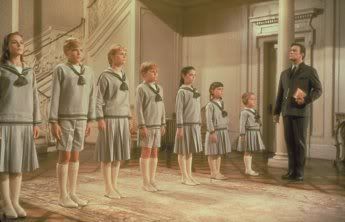
Carol Lynn describes the setting of this film as a sad, militaristic patriarchal household. Discipline is the order of the day, imposed by the “Captain.” Titles and the military are important in patriarchal thought, Carol Lynn observes. Into this situation comes the magical woman. Down from the hills, the holy woman, right out of the convent. She is a troublemaker. The captain is not pleased. She brings a female presence into the household. She sings of very feminine things. She works her magic with the children. The children sing the song that Maria taught them, and Captain is amazed “You brought music back into the house. I'd forgotten. Please stay.” To this Carol Lynn comments, "What a day it will be when our patriarchy says, 'You’ve brought the feminine back into the house, I’d forgotten, please stay.'" In her recounting of this story, Carol Lynn seems to see Maria as symbolic of both the Heavenly Mother and symbolic of those in the Church who work to see her recognized as a valid and vital reality in Mormon theology. These women (and men, sometimes) are troublemakers. Their goal is to bring the Divine Feminine to the forefront, where the entire Church can feel her effect upon them.

Soon the Spirit of the Feminine is banished from the Von Trapp household. Her loss is sorely felt. The children go to the abbey to get her back. Says Carol Lynn: "Children should not be passive when they need their mother back. I have a right to knock on any door and demand my mother back." I am continually surprised and delighted to observe how Carol Lynn gets away with saying things like this. Many others have been disciplined for less. I know I'd never be able to get away with a statement like that. Readers, what do you think protects Carol Lynn from the watchful eye of the patriarchy? Is it a good relationship with local leadership? Is it her admired public persona?


At the conclusion of "The Sound of Music" the organ plays a wedding melody, which segues into “how do you solve a problem like Maria?" We now know that instead of being the problem, Maria is the answer. Carol Lynn asks her audience: "How do you solve a problem like Lavina? Or Janice? You love them, allow them, support them-- helping to transform the patriarchal household into a partnership." I often wonder how this could have been done. How could Lavina's and Janice's and Margaret's ideas been integrated and supported and loved by a patriarchal leadership? What a fascinating era it would be to even today have the voices of these intelligent spiritual women heard in the mainstream Church. Having rubbed shoulders for a small time with each of them, I recognize their strivings to have the Spirit guide their lives and their teachings as much as the majority of male leaders I have encountered.

As the film ends, the "fatherland" calls, but the Captain has now been enlightened. He recognizes the value and power of a combined male/female unit. He has greater resources, and with the help of the Holy Woman, he and his family climb the mountain to freedom. Carol Lynn ends her exposition on this film with these words: "I invite the patriarchy to fall in love with me and I promise to be a devoted and useful partner."

(Succeeding posts will address Carol Lynn's thoughts on "The Secret Garden" and "Mary Poppins.")

Labels: ,

Wednesday, March 28, 2007

Life in a Motherless House

This week I received my tape of Carol Lynn Pearson's talk, "Mary Poppins and the Return of God the Mother" from the 1998 Sunstone Symposium. In the talk she speaks of the Church as a "motherless house." Carol Lynn says that she has found that the longing for a Divine mother is a universal hunger which pops up in the collective unconscious often. To illustrate this she mentions several well known films which speak of the transforming of the patriarchal family through the receiving of the divine magical woman. I plan to outline Carol Lynn's conclusions about these films, but first I would like to ask a question of any males that happen across this blog. Do you feel the lack of a mother figure in our Church? We have a Heavenly Father, and we have a "father of the ward" (bishop), both of whom are heavily involved in our daily lives. It is to the Heavenly Father that we pray several times a day. It is the Bishop who gives us the callings which often define us and take up so much of our time. We are told that we have a Heavenly Mother, but that we need not strive to know her personally. We have women who affect us and teach us in Primary, but after the age of 12, males have no further contact with women in the Church as authority figures nor are women Church leaders available to them for guidance or counsel (as men are available to women in the Church). Do you feel that this constitutes a "motherless house?" Do you ever feel longings for a spiritual feminine?

More about Carol Lynn's talk to come!

Labels: ,

Thursday, December 28, 2006

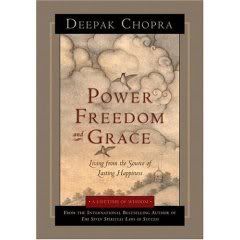
Power, Freedom, and Grace

I picked up the book "Power, Freedom, and Grace" by Deepak Chopra recently to read as part of my spiritual triathlon readings and meditations. It seemed the "right book" to meditate upon when I read these words in the first chapter:

There is a reason why you were drawn to this book. Perhaps your soul is extending an invitation to you--an invitation to get in touch with the deepest part of yourself.

Reading this small volume has indeed been enlightening. There are several sections which have brought back experiences I needed to remember and write down. For example, here is one of the quotes I encountered.

...the real you--that you that we call pure consciousness, the field of intelligence, the inner self, the soul, the spirit, the infinite consciousness, the Being within you...If you get in touch with this presence, if you really become intimate with it because it's your own inner self, then you will know experientially, without anybody telling you, that this presence was there before you were born, and it will be there after you die.

Before I joined the Church I had concluded that there was some part of my essence which had always existed and I couldn't imagine that it would ever cease to exist. That is why the teachings on the premortal existence of spirits resonated so much. Sometimes I wonder if LDS who are taught this from an early age have an advantage or a disadvantage. It could be a disadvantage if it keeps one from gaining the experiential knowledge of one's own soul of which Chopra speaks. On the other hand, the teaching could encourage the search for a more intimate knowledge of the inner self.

Slowly, by spending time in silence, you notice that the scenery comes and goes, but the seer is always there. You realize that you are not the scenery; you are the seer, the witness of the scenery. As you shift your
identity from the scenery to the seer, everything starts to slowly awaken. You glimpse the soul, and you begin to experience more expansive states of consciousness...

I experienced this one time in the temple. I had arrived and finished the session early in the morning. I sat in the celestial room for quite a while, until the next session came through and left. And still I sat as time began to have no meaning. Two more sessions came and went, and I observed, detatched. People seemed to enter the room, move about, and exit hundreds of times. Then there would be a space of rest and contemplation. I seemed to see temple work being done over a period of many years, in many different places around the world. My being seemed to be above it all and disconnected from time and space.

In my conversion, one of the great appeals of Mormonism was the mystical experience of a living prophet, and the promise that each member could receive personal revelation. Years of experience in the Church have taught me that these manifestations must remain personal. Following commandments and the performance of good works are emphasized in talks, lessons and publications. It's not that we don't believe in personal encounters with Deity, rather, they are inappropriate to discuss publicly. Unfortunately, I have allowed the mystical to be relegated to the background of my spiritual life.

I do believe that the praxis of religion is important to the development of the soul, and I don't intend to deemphasize this aspect. But perhaps there is a reason I am being drawn back to the transcendental facet of religion. Perhaps my soul is extending an invitation to get in touch with the deepest part of myself.

Labels:

Tuesday, December 05, 2006

God is Love


I had the most amazing experience as I embarked on my “spiritual triathlon” training. The first day was inaugurated with a 20 minute meditation. I sat down in a sunny spot on my living room floor and crossed my legs. I had determined that I would meditate on the phrase “God is Love.” I resolved to keep it simple, and not to delve into the nature of Deity or my own shortcomings or anything too deep or depressing. So: God is Love, I thought. And immediately I felt a huge powerful sensation overwhelm me. This was no warm feeling in the bosom. I felt like I was having an orgasm inside of my chest. And it wasn’t the only peculiar reaction I was to experience. Since I am a P.E. major and (sometime) athlete, I am pretty familiar with my heart rate—I can tell when my heart is beating at the optimum rate for exercise. Well, the funny thing about me is that when my heart rate is slow I have a difficult time finding a pulse. I can only feel it after I’ve done a bit of exercise and my heart is pumping pretty fast. So in this meditation I start feeling my heart rate. It is thumping in my ears and my head—and it’s Really Slow! Like, abnormally slow. So I just sat and pondered about how God is Love and I’m pretty sure I connected with some type of force outside of myself which caused some strange sensations and physical reactions. And it had the result of making me feel very, very good about myself, in fact: I am loved. And the feelings I’ve encountered in the last few months when I’ve felt that I haven’t been loved are so much the opposite, dark, and heavy.
I found that I could only meditate for about 10 minutes before I lost control of my thoughts. I had to peek at the clock to see how long I’d been meditating. I stuck it out for the remaining 10 minutes and the feeling didn’t go away, but I had to really keep saying to myself, “God is Love,” instead of being immersed in it like I was at first. So I see that I’m “out of shape” spiritually and I’m expecting that it will probably get easier to do. But all day long I could revisit the mantra “God is Love,” and I got that powerful feeling to come back to me. Now I feel like I can relate to people who have had “ecstatic experiences” because ecstatic is really a great word for it. And I wish my writing was a whole lot better than it is because I want to be able to describe this experience sublimely and perfectly.

This writing thing is a lot more difficult than the meditation because I start to try to analyze and wonder if I should trust what happened or if it was just some kind of psycho-physical or depressive-manic thing. Especially putting it out there for people to read. I guess I’m sensitive to what people’s perceptions of me are, and I know I might look like a kook or idiot or people will wonder if it is all for real. But I guess it is part of taking off the mask. I’ve suspected for a long time that that real face of mine is just not going to fit in any which where.

Labels:

Monday, December 04, 2006

Spiritual Triathlon


I've been thinking about offering a triathlon training class over at the Rec Center, so I was online checking out some of the suggested triathlon training schedules. The schedules for the sprint triathlons look something like this:


First Week:

Mon 40 min Bike
Tue 15 min Swim, 20 min Run
Wed off
Thu 35 min Bike
Fri 20 min Run
Sat 30 min Swim
Sun off

Then they get progressively more difficult for 16 weeks until you are ready for the race.

Suddenly I had a great idea for a personal training program: I would prepare for a Spiritual Triathlon! You know, the kind Enos did when he prayed in the forest all day and all night? The longest I've ever done something like this was when I did a contemplation for about 2 hours at Moon Lake one time. So, since I'm probably a bit out-of-shape, I put together a training program for myself for the next 16 weeks. It's going to start out pretty easy. I will concentrate on three areas.

1. Prayer/Meditation/Contemplation--I want to try several different forms
2. Reading--Scriptures and writings of Spiritual Seekers
3. Journaling--setting down of spiritual ideas into writing

This will be in addition to my(rather pitiful) regular prayer/scripture study time--which I must admit lasts no longer than 10 or 15 minutes before bed.

I'll push myself a little more each week until March 31st when hopefully it will get warm enough for me to go out into the mountains and do my Spiritual Triathlon. Here is my schedule for this week:

First Week:

Mon 20 min Meditate
Tue 30 min Write
Wed Temple
Thu 40 min Read
Fri 3o min Write
Sat 20 min Meditate
Sun Rest

I'm hoping that as I begin to meditate and write my reasons for doing this will become more clear and I will start to move in some kind of direction. Also, I hope to be directed in what I'm going to be doing out on the mountain all day! Anyway, it's my attempt to get myself going in some sort of positive direction. I haven't had much energy to do anything else of value, and this seems to be enticing to my spirit.

Labels:

Thursday, November 30, 2006

Taking Off the Mask

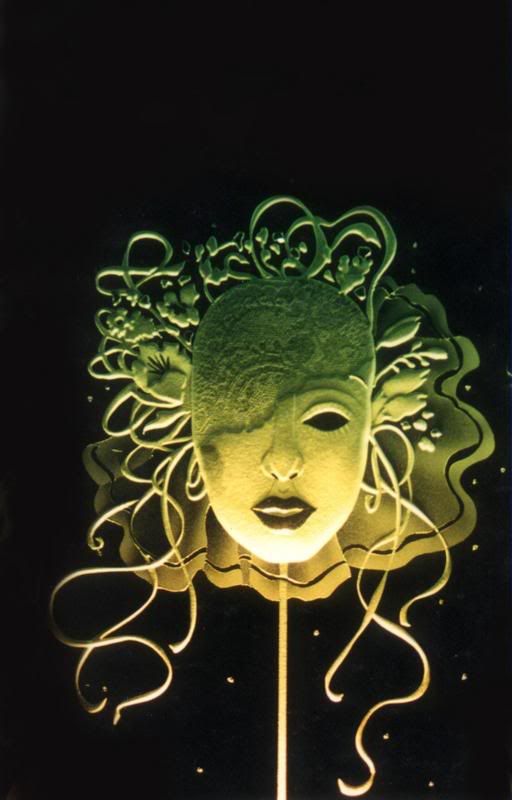
Years ago I read a section in C.S. Lewis’ small book “Beyond Personality” that tells the story about “someone who had to wear a mask; a mask which made him look much nicer than he really was. He had to wear it for years. And when he took it off he found his own face had grown to fit it. He was now really beautiful. What had begun as a disguise had become a reality.” The author’s point was that the Christian should dress up as Christ—behave as if they really possessed the attributes of the Savior. Eventually these things would actually become part of their personality.
That young, idealistic girl who read the story immediately put on the mask. I’ve worn the mask for years, trying to become the perfect Mormon girl.

I don’t know what I’m doing wrong. The face beneath has not grown to fit. The mask was comfortable for a while; especially when I was a SAHM of eight, fulfilling callings in the Church and pouring all of my energy into keeping the family going. But as far as helping me become more like Christ, the mask has been a miserable failure. Pretending to be kind and sweet to all I meet has not made me more kind. Pretending to be obedient, humble and submissive has made me a hypocrite.

Now the mask is popping off with a vengeance. (Picture Jim Carrey in reverse: me trying to hold the mask on my face, the mask throwing me every which way trying to pull itself off.) I know the mask’s days are numbered. But I’m afraid to show my true face. I haven’t seen it for so long. Is that true face an ugly, warted monstrosity? Is it a failure to live up to the commitments I made and become a truly Christlike person? Please don’t discount this possibility. This is the point of view of all who are dear to me and I halfway believe it. But somewhere deep down I wonder if my true self might be nice to look at. It might be nice to live with. It isn’t what I was aiming for, but it might be all I have.

Labels:

Monday, September 18, 2006

Singing A Capella

This was originally posted at BCC.

Last Sunday my daughter had her missionary farewell—oops, I mean, she gave a talk in her singles ward, along with another young man who was going on a mission. The two sang an arrangement of “A Marvelous Work.” The boy’s father, an accomplished musician, accompanied them on the piano. I, the proud mother, thought they did a fabulous job. Except, in the middle of the song, the piano stopped playing. At first, I and the rest of the congregation simply thought they were singing a cappella. Their voices blended wonderfully. But then the boy cast a glance at his father, and I realized the pianist was frantically searching for a missing page. He finally found his place, came in on the last page, and all had stayed on key. My daughter told me later she was shaking and clinging to the podium during the “a cappella” section.

This incident made me ponder the times when we are singing a cappella through life. Sometimes it feels as if the Lord has deserted us; left us without accompaniment in this lone and dreary world.

Is he really right there with us all the time, totally involved in our lives, and due to lack of spiritual sensitivity we just can’t tell? (a la “Footsteps in the Sand?”) Does he withdraw for a time so that we can learn and grow? Or has he placed us here to make our own way through life by faith, with little or no personal contact? At times in my journey, I’ve subscribed to each of the three positions.

1. The most scriptural support comes down on the side of the first option. “and lo, I am with you alway, even unto the end of the world.” (Matt 28:20) In fact, D&C 59:21 warns us that God’s anger is kindled against those who do not acknowledge his hand in all things. I would like to think that the Lord himself is continually taking a very personal interest in the details of my small life. But the only people I know who really live this philosophy are just a bit kooky. My friend TJ, a born-again Christian, believes much as Corrie Ten-Boom that any little flea that comes along is there for a cosmic purpose. Whenever TJ so much as drops an egg on the floor, she will loudly proclaim, “Praise the Lord!”

2. When mankind turned to wickedness in the days of Noah, Jehovah told them, “My Spirit shall not always strive with man.” (Gen. 6:3; see also 2 Ne. 26:11 and D&C 1:33)
Perhaps this is true not only for the wicked, but for all. In the temple, where Adam and Eve stand as representatives of the human race, the Lord tells them that he will go away, but he will return and give them instructions from time to time. Many mainstream Latter-day Saints seem to hold this view.

3. You need not run the risk of being branded an apostate if you hold the third view. It is a comfortable place for Latter-day Saints who believe that “Surely the Lord God will do nothing, but he revealeth his secret unto his servants the prophets.” (Amos 3:7) We have the scriptures and the revealed word of the Lord to direct us through life. This is enough to guide us and bring us back into the Father’s presence without the necessity of his personal intervention in the affairs of the common person.

How are we to know if the Lord is carrying us through the sand when it feels as if we are singing alone into the wind? Does a strong faith necessitate a belief in his ongoing presence? Should we strive to assimilate one of these paradigms, or is it OK to just follow what we’ve been told, cling to the podium, and wait for the accompanist to come back in?

Labels: , , ,

Saturday, September 16, 2006

Visual, Auditory, and Kinesthetic Revelation


Visual, auditory, and kinesthetic learners are so named because they respond to learning in different ways. Visual learners are responsive to stimuli they can see. Auditory learners do well in traditional classrooms because they learn by hearing. Kinesthetic learners grasp concepts better when they can feel and handle models of the material being taught. I believe that revelation is given to people in a similar way, according to how the individual can best process the information.

Lehi’s vision was given to him in images. When he described the vision to his family, he told them all the things he saw. “I saw in my dream a dark and dreary wilderness,” he states. “I saw a man…I beheld a large and spacious field…I beheld a tree…I beheld that the fruit thereof was white...I cast my eyes round about…I beheld a river of water…I beheld your mother Sariah, and Sam, and Nephi…I cast mine eyes toward the head of the river, that perhaps I might see [Laman and Lemuel]…I saw them, but they would not come unto me…I beheld a rod of iron…I also beheld a straight and narrow path…I saw numberless concourses of people…I also cast my eyes round about, and beheld, on the other side of the river of water, a great and spacious building…” Because of the things which Lehi saw, he made conclusions about what the Lord wanted to communicate to him. Lehi began to fear for Laman and Lemuel. He preached to them and exhorted them to keep the commandments of the Lord. This dream was given to Lehi in a visual manner. Other visual revelations recorded in scripture include Moses’ vision and Joseph F. Smith’s vision of the redemption of the dead.

Enos had an experience with God that was no less immediate than that of Lehi. His revelation, however, came in an auditory form. Enos carried on a conversation with his Maker. “I did raise my voice high that it reached the heavens…there came a voice unto me…and I said, Lord, how is it done…and he said unto me, because of thy faith…when I had heard these words I began to feel a desire…I did pour out my whole soul unto God for them…the voice of the Lord came into my mind…after I, Enos, had heard these words…I prayed unto him with many long strugglings…after I had prayed and labored with all diligence, the Lord said unto me…I did cry unto God…and the Lord said unto me…” Because of the things which he heard, Enos went about among the people prophesying and testifying. His auditory experience with the Lord had a great effect upon him. Other auditory forms of revelation in the scriptures include Samuel’s call and instructions to Elijah.

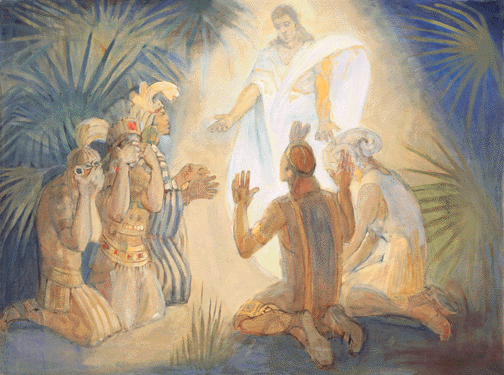
Alma’s revelation came in a kinesthetic form. As he went about with the sons of Mosiah persecuting the people of the Church, an angel appeared to them and spoke, saying, “seek no more to destroy the Church of God.” Immediately Alma fell to the earth. Although he had seen (visual) and heard (auditory) the angel, the revelation came to Alma kinesthetically. For three days and nights he could not open his mouth. He states that the angel spake more things, which were heard by his brethren, but he could not hear them. “I was struck…I fell to the earth…I did hear no more…I was racked with eternal torment…my soul was harrowed up to the greatest degree and racked with all my sins…I was tormented with the pains of hell…for three days and three nighs was I racked, even with the pains of a damned soul…I could remember my pains no more…oh, what joy and what marvelous light…my soul was filled with joy as exceeding as was my pain…my limbs did receive their strength…I stood upon my feet and did manifest unto the people that I had been born of God.” Alma’s experience, which came kinesthetically, had such an effect as to completely change the course of his life. Other examples of kinesthetic revelation are the shocking of Laman and Lemuel and the lightening of the burdens of Alma and his people.

Often a revelation will employ two or even all three of these methods in order to bring the word of the Lord to the listener. In Joseph Smith’s vision, he felt the power of the adversary, saw God and Jesus Christ, and heard their voices.

In cases when I feel that I have received revelation, it has come to me in a rather auditory form. I compare it to what Joseph Smith described as “sudden strokes of ideas,” which I recognize as pure intelligence. These ideas come as words, and I am often able to write down exactly what is being communicated. My husband, on the other hand, experiences revelation very visually. It is usually in the form of dreams, in which he sees images that he recognizes as having symbolic meaning. Many members of the Church have felt kinesthetic revelation in the form of “a burning in the bosom,” or a warm, peaceful feeling.

Do you experience revelation in any of these three forms? Does it come in one way more often than others? Do you feel that the revelation is being sent to you in the manner in which you are best able to receive and learn from it?

Labels: ,